Georgia Civil War Commission

Georgia's Civil War
— Fully Explored

History. Stories. Travel. Education. Your complete guide to the Civil War in Georgia — from the mountains of the High Country to the marshes of the Coast.

Explore
Who are you visiting as?
🗺

Traveler & Visitor

Plan a heritage road trip — battlefield parks, museums, and historic homes with hours and admission info.

Plan Your Visit →
📚

Educator

Georgia Standards-aligned lesson plans, primary sources, videos, and field trip guides for all grade levels.

Browse Resources →
🔍

Researcher

Primary source repositories, digital archives, bibliographies, and research guides for the Civil War in Georgia.

Start Researching →
📖

History Buff

Deep-dive stories of generals, soldiers, civilians, and enslaved Georgians — linked to the places where they lived.

Read the Stories →
120K
Georgians Served the Confederacy
3,500
Black Georgians Served the Union
508
Acres Preserved at Resaca
220+
Historic Sites Across Georgia
30+
Years of Commission Service
Explore Georgia's Civil War

Your One-Stop Resource for
Georgia's Civil War Heritage

From battlefield tourism to classroom education, from personal stories to scholarly research — everything you need about Georgia's Civil War in one place.

📜
Civil War in Georgia

The Full Story: Georgia & the Civil War

From Georgia's road to secession in 1861 through the Atlanta Campaign, March to the Sea, and the War's end — the definitive narrative, from the mountains to the coast.

Read the Overview →
⚔️
Stories

Generals, Soldiers & Civilians

Personal stories of the men, women, and African Americans who lived through Georgia's Civil War — each story linked directly to the battles and places where history happened.

Explore Stories →
🗺
Heritage Tourism

Plan Your Visit to Georgia's Civil War Sites

Battlefield parks, museums, historic homes, and cemeteries — with practical visitor information including hours, admission, and tour types.

Plan Your Trip →
Our Mission

The Georgia Civil War Commission coordinates the planning, preservation, and promotion of structures, buildings, sites, and battlefields associated with this significant period of our shared heritage — ensuring that future generations understand the full depth and complexity of Georgia's experience during the Civil War.

— Georgia General Assembly, Senate Resolution 21, 1993
📅
On This Day in Georgia's Civil War
1864

Battle of Resaca Begins

General Sherman's Army of the Tennessee, having passed through Snake Creek Gap, engages General Johnston's Confederate forces at Resaca — the first large-scale battle of the Atlanta Campaign. Fighting will continue for two days with combined casualties of nearly 5,500 men.

Read the full story of Resaca →
Featured Stories

From the People of Georgia's Civil War

⚔️
Generals

Johnston vs. Davis: The Campaign That Lost Georgia

The conflict between a cautious general and an impatient president — and how it shaped the Atlanta Campaign.

🚂
Soldiers

The Great Locomotive Chase

The most daring raid of the Civil War — from Big Shanty to Ringgold, through the heart of Confederate Georgia.

🌹
Women

Mary Green and the Resaca Cemetery

How one woman's act of devotion created one of Georgia's most poignant Civil War landmarks.


Latest from the Blog

News & Updates

🏛
Preservation

Commission Supports Resaca Battlefield Expansion

New acreage added to one of the Atlanta Campaign's most significant and best-preserved battlefield sites.

📅
Events

2025 Battle of Resaca Living History Weekend

Join us May 16–18 for the annual reenactment and living history program at the Resaca Battlefield.

📚
Education

New Classroom Resources Now Available

Updated lesson plans aligned with Georgia Standards of Excellence for grades K–12, available for free download.


Education

Learning Georgia's Civil War
Inside the Classroom & Beyond

The Commission is committed to bringing Georgia's Civil War history to life for students of all ages — through lesson plans, videos, and hands-on resources that connect the classroom to the battlefield.

📋

Lesson Plans & Activities

Classroom-ready lesson plans and activities bringing the Civil War in Georgia to life for students at every grade level — from elementary through high school.

Browse Lesson Plans →
▶️

Videos

Educational videos covering Civil War life, food, technology, and more — ideal for classroom viewing, independent study, and field trip preparation.

Watch Videos →
🗺

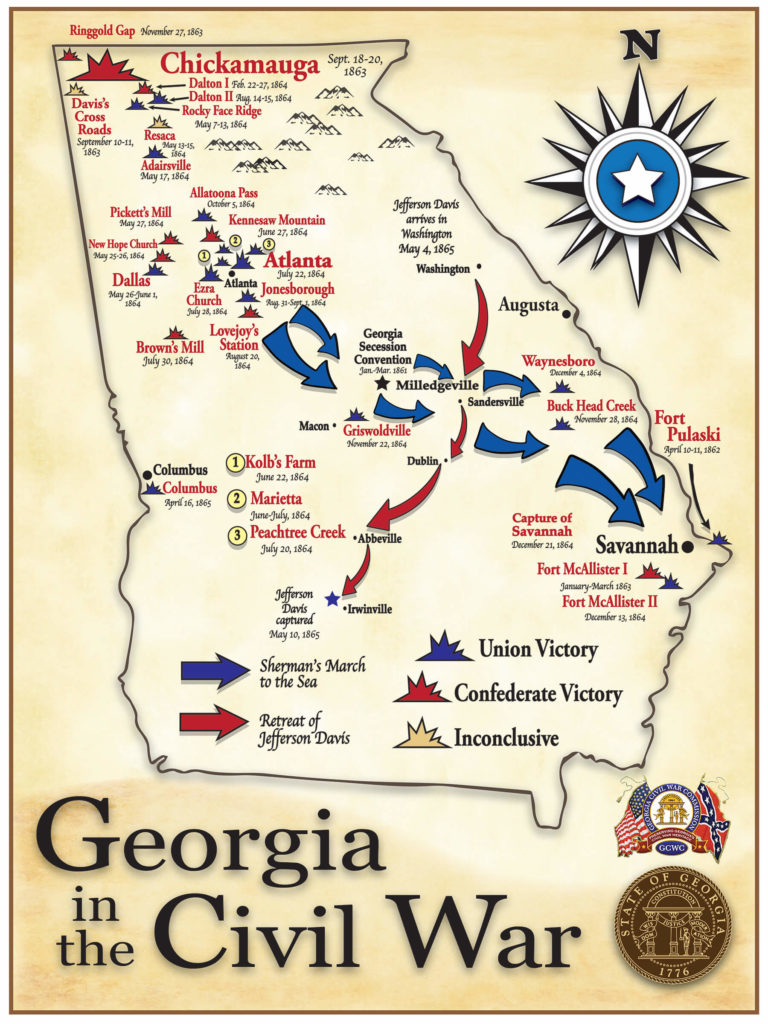
Georgia in the Civil War Poster

A detailed illustrated map of Georgia's Civil War sites, battles, and campaigns — a valuable classroom reference and an excellent companion to any Georgia history unit.

View & Download the Poster →
Home / Education

Educational Resources

Lesson plans, videos, and resources to help students and educators explore Georgia's Civil War history inside the classroom and beyond.

📋

Lesson Plans & Activities

Classroom-ready lesson plans for elementary through high school, covering the home front, campaigns, and life during the Civil War.

Browse Lesson Plans →
▶️

Videos

Educational video series on Civil War life — rations & food, technology, textiles, industry, and more — ideal for classroom use.

Watch Videos →
🗺

Georgia in the Civil War Poster

A detailed illustrated map of Georgia's Civil War sites, battles, and campaigns. Free to download and print for classroom display.

View & Download →
Home / Education / Lesson Plans & Activities

Lesson Plans & Activities

Curated lesson plans and classroom activities for teachers bringing the Civil War in Georgia to life for students at every grade level.

The following lesson plans and activities have been selected by the Georgia Civil War Commission to support educators in teaching this significant chapter of Georgia and American history. Resources span elementary through high school and draw on primary sources, battlefield scholarship, and standards-aligned curriculum.

📜
High School

Effects of the War — 1865 & Beyond

Students compare the United States before the Civil War to the nation that emerged after it — examining economic, social, and political transformation in the war's immediate aftermath.

Open Lesson Plan at battlefields.org →
📔
Primary Source / All Levels

The Days of Julia Johnson Fisher: A Civil War Diary

Julia Johnson Fisher kept her diary over an eight-month period in 1864, chronicling life in Camden County along the south Georgia coast. Rich in descriptive detail about wartime deprivation, family life, and social order, this resource offers students direct access to a Georgia woman's wartime experience.

Explore the Diary Resource →
🌾
Elementary School

The Home Front

Students list examples of work done on the home front and describe how news traveled from the battlefield to families waiting at home — connecting children's everyday lives to the wartime experience.

Open Lesson Plan at battlefields.org →
🚶
Middle & High School

Sherman's March to the Sea

This activity helps students understand how Sherman's "March to the Sea" was one of the most controversial aspects of the later Civil War. Sent by Grant to "create havoc and destruction of all resources that would be beneficial to the enemy," Sherman's campaign reshaped modern warfare and left a lasting mark on Georgia.

Open Activity at PBS.org →
🏫
All Levels — Teaching Strategies

Ten Classroom Strategies for Teaching the Civil War

With an eye on a ten-month school year, these ten proven classroom strategies — developed by educator James A. Percoco — have been successfully used to teach the American Civil War at multiple grade levels.

Read the Strategies at battlefields.org →
📚
Secondary — Comprehensive Curriculum

The Essential Civil War Curriculum

A sesquicentennial project of the Center for Civil War Studies at Virginia Tech, sponsored by eminent Civil War scholars Dr. James I. Robertson and Professor William C. Davis. A comprehensive curriculum resource for secondary educators.

Explore the Curriculum →
Home / Education / Videos

Educational Videos

Video series exploring the daily life, food, technology, and experiences of Civil War soldiers and civilians — ideal for classroom use, independent study, and field trip preparation.

🍽 Rations & Foods

How Civil War soldiers prepared and ate their daily rations — from hardtack to coffee to salt pork.

Current Category

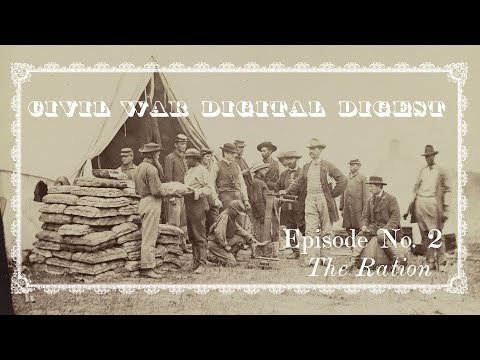
Civil War Rations: An Overview

Civil War Rations Overview

Civil War Digital Digest gives an overview of the prescribed rations for Union soldiers and discusses their variances. This episode will set the stage for a number of episodes about the rations and what to do with them.

▶ Watch on YouTube →

Making Hardtack More Edible

Making Hardtack Edible

Learn how a soldier made hardtack more edible! William Bircher of the 2nd Minnesota Infantry wrote this recipe.

▶ Watch on YouTube →

Brewing Coffee in Camp

Brewing Coffee in Camp

Caffeine headache? Don't worry! Here's a recipe from an original source showing how soldiers might have brewed their "cup of joe" when in a camp situation.

▶ Watch on YouTube →

Preparing the Beef Ration

Preparing the Beef Ration

It wasn't all salt pork for the meat ration of the Union soldier. Beef was also issued. Volume II of Civil War Digital Digest starts with a period soldier's recipe for preparing issued beef.

▶ Watch on YouTube →

Army Cooking: General Casey's Help

Army Cooking General Casey

At the beginning of the war, army cooks were provided mess kettles, pans, and little information — they were usually men detailed from the ranks for the duty. General Silas Casey recognized this weakness and decided to help.

▶ Watch on YouTube →

Preparing Flour in the Field

Preparing Flour in the Field

Flour was one of the more perplexing ration items for a soldier to deal with in the field. The army could issue flour in the form of "bread." How do you prepare it?

▶ Watch on YouTube →

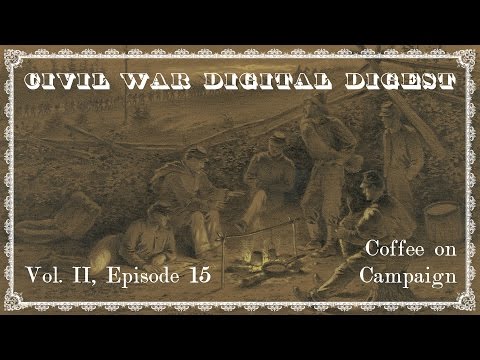
Coffee on Campaign

Coffee on Campaign

It doesn't matter whether you are at home in the 21st century or a Civil War regimental camp in the 19th — Americans need coffee! Episode 15 shares a veteran's memories of making coffee while on campaign and warns of the pitfalls awaiting the inexperienced soldier.

▶ Watch on YouTube →

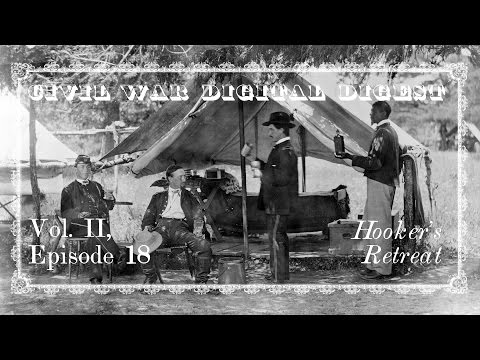
Hooker's Retreat

Hooker's Retreat

Alcohol was forbidden for men in the ranks through the war — though officers were allowed to have it. One officer developed a drink that became so popular his comrades mentioned it in their journals. Developed after the Battle of Chancellorsville, he named it "Hooker's Retreat."

▶ Watch on YouTube →

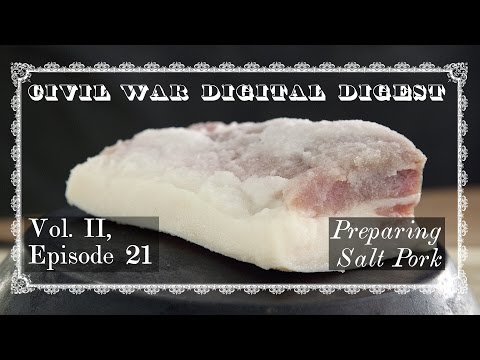
Preparing Salt Pork

Preparing Salt Pork

Salt pork was a staple in soldiers' diets on both sides of the war. The salt was a preservative that allowed the meat to arrive at the front safe to consume. However, it took some work to make it palatable.

▶ Watch on YouTube →

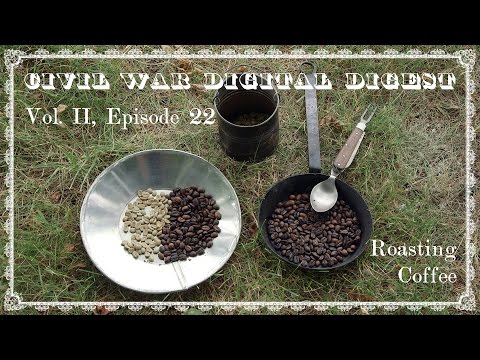
Roasting Green Coffee Beans

Roasting Green Coffee Beans

Soldiers loved a good cup of coffee — then the ration arrived with the beans still green. Episode 22 teaches how green coffee beans can be roasted in camp, featuring a memory left by a surgeon from the 18th Ohio Infantry.

▶ Watch on YouTube →

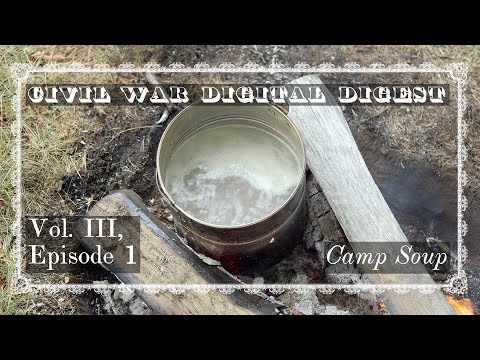
Camp Soup

Camp Soup

Have the US ration? Need a meal but don't know what to do? Are you in one place for a little bit? Make soup! To open Volume III, we prepare a recipe provided by the Beedle Dime Company to soldiers for "Camp Soup."

▶ Watch on YouTube →

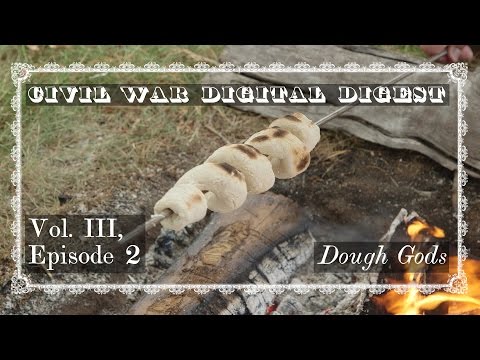
Dough Gods

Dough Gods

One way the bread ration could be issued was to give the men flour. How could they handle that in the field? In this episode, we explore how "dough gods" were made — a simple recipe recorded by William Bircher, a drummer in the 2nd Minnesota Infantry.

▶ Watch on YouTube →

Cornmeal Mush

Cornmeal Mush

Want to learn about a simple dish for soldiers on both sides? In this episode, we demonstrate how to make a simple, hot, filling meal out of cornmeal. Cornmeal mush is documented on both sides of the war — it is much better than it might sound, and easy to try at home or in the field.

▶ Watch on YouTube →

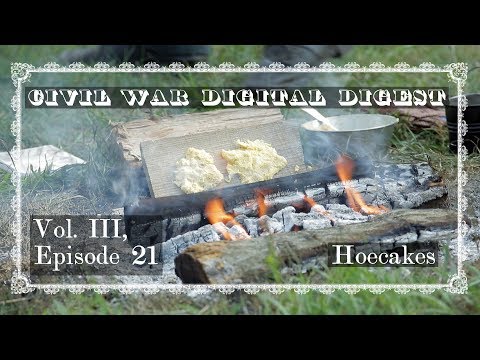
Cornmeal Hoecakes

Cornmeal Hoecakes

In this episode, we demonstrate taking minimal ingredients and cooking implements to make a meal in the field. Cornmeal hoecakes are documented on both sides of the war — the method we demonstrate is explained in an 1861 soldiers' handbook and uses just a wood plank to bake on.

▶ Watch on YouTube →

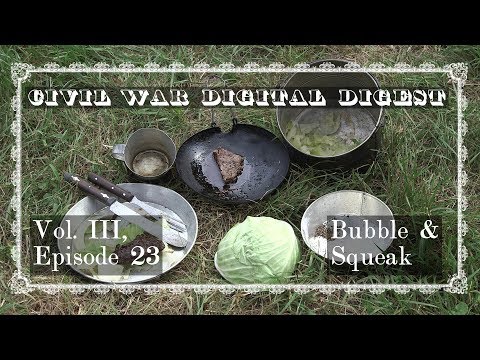
Bubble and Squeak

Bubble and Squeak

Bubble and squeak is a dish familiar to many. See this Civil War soldier's version from a handbook aimed at helping recruits. Camp Fires & Camp Cooking, or Culinary Hints for the Soldier was written by Captain James M. Sanderson and published in January 1862.

▶ Watch on YouTube →

Frying Meat with Gravy

Frying Meat with Gravy

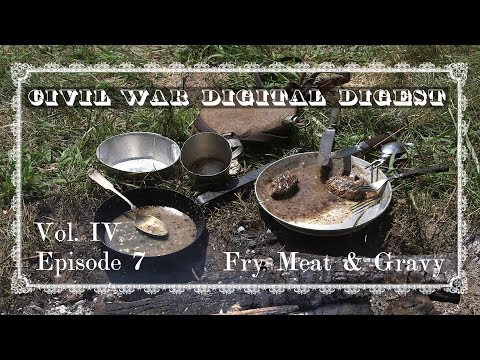
This episode continues our exploration of how to prepare rations in the field. Frying meat is a quick and simple preparation, and we take it up a notch with a simple, flavorful gravy using the ration's fresh beef, flour, vinegar, salt, pepper, and pork grease.

▶ Watch on YouTube →

Rice Pudding in the Field

Rice Pudding in the Field

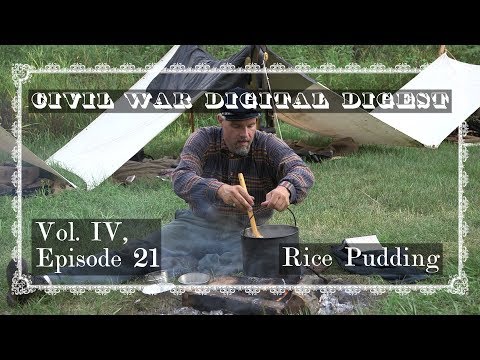
In this episode, we prepare rice pudding in the field. The recipe comes from the Military Handbook and Soldiers Manual of Information, published in 1861 — a great way to liven up the simple rice ration and even make a dessert in the field.

▶ Watch on YouTube →

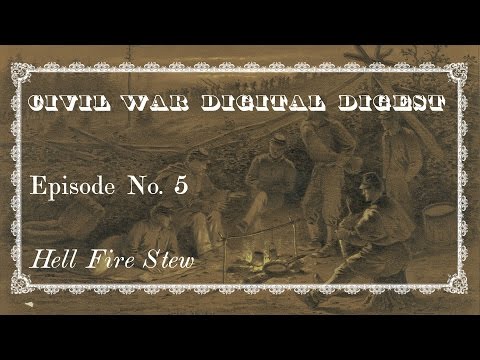
A Sergeant's Stew

A Sergeant's Stew

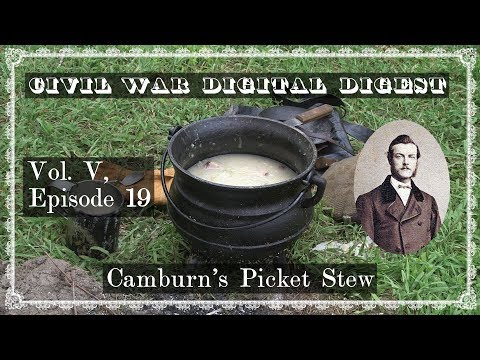
In this episode, we bring you a sergeant's account of a stew he made while on the picket line for his men — using ration items from the men and foraged ingredients, including the equipment needed for cooking. While preparing the stew, there is a chat about the need for soldiers to share the workload and for sergeants to care for their men.

▶ Watch on YouTube →

Hominy

Hominy

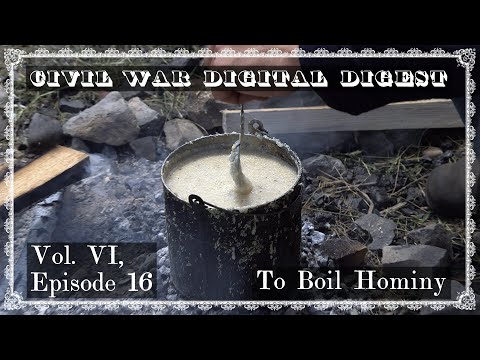
The time has come to dig into hominy! This episode covers what hominy is and one way to make it edible over a small campfire. This simple yet documented method leads to additional cooking options later for any leftovers.

▶ Watch on YouTube →

Slapjacks and Flapjacks

Slapjacks and Flapjacks

Many enjoy a warm stack of fluffy pancakes covered in syrup! In this episode, we share two veterans' accounts — one Confederate and one Union — describing how they made pancakes, or as they called them, slapjacks or flapjacks. These might be slightly different from what you enjoy today since soldiers often had limited ingredients.

▶ Watch on YouTube →

Hardtack Cutters Reviewed

Hardtack Cutters

Interested in learning how to replicate hardtack, a staple of the Union soldier's diet? Just request it! Three different manufacturers make hardtack cutters — we review all of them in this video.

▶ Watch on YouTube →

Making Salt Pork Tender

Making Salt Pork Tender

How do you make salt pork tender and good to eat? In this episode, that question is answered — it is not hard to do; it just takes a little patience! A soldier who served in the 17th Michigan Volunteer Infantry left behind the method and directions.

▶ Watch on YouTube →

Hominy Leftovers at Fort Wayne

Hominy Leftovers at Fort Wayne

We are back at Historic Fort Wayne in Michigan to share what to do with hominy ration leftovers! A veteran shares one idea of what to do with all that leftover hominy the next day. If you are unfamiliar with hominy, we encourage you to try using these two methods as a great way to connect with history.

▶ Watch on YouTube →

Beef Stew from the Hospital Stewards Manual

Beef Stew Hospital Stewards Manual

A hot stew on a cold January evening is enjoyable today and would have been welcomed in Civil War-era hospitals. The source for this simple beef stew recipe comes from an original copy of the Hospital Stewards Manual.

▶ Watch on YouTube →

Coffee from the Hospital Stewards Manual

Coffee Hospital Stewards Manual

John Billings wrote in Hardtack and Coffee: "Drunk my pint or so of coffee, and felt as fresh and invigorated as if just arisen from a night's sound sleep!" In this episode, a bracing kettle of coffee is prepared with directions from the Hospital Stewards Manual.

▶ Watch on YouTube →

Private Grove Sevey's Coffee

Private Grove Sevey's Coffee

Coffee is the elixir of life — especially to the Civil War soldier! Join us as we use Private Grove Sevey's diary notes to make coffee according to his specifications. Grove was a member of the 17th Michigan Infantry, and we are thankful to historian Bill Christen for sharing this transcription of his diary.

▶ Watch on YouTube →

Hardtack Crate Utilitarian Builds

Hardtack Crate Builds

The Union armies consumed massive amounts of hardtack during the war — each soldier was allotted a pound per day, and a crate held 50 pounds. The men learned to repurpose these "Amazon cardboard boxes" of their day in many valuable ways. In this episode, Will takes a look at a couple of documented utilitarian crate builds.

▶ Watch on YouTube →

Edward Wade's Best Cup of Coffee

Edward Wade's Coffee

In this episode, enjoy a new twist on a soldier's favorite drink — coffee. It's a new twist that is 162 years old! Thanks to Spared and Shared, we have access to a letter written home by Edward Wade of the 14th Connecticut, in which he tells his wife about the best cup of coffee he has ever had.

▶ Watch on YouTube →

Coffee and Its Substitutes

Coffee and Substitutes

Coffee is one of the most consumed beverages in the world, and that was no different for Civil War soldiers of the 19th century. Join historian Douglas Ullman, Jr. as he details the consumption of coffee and its substitutes in Union and Confederate camps from 1861 to 1865.

▶ Watch on YouTube →

What Civil War Soldiers Ate

What Civil War Soldiers Ate

Douglas Ullman Jr. of the American Battlefield Trust details what Union and Confederate soldiers ate during the Civil War. Would you be able to live on the same diet as Civil War soldiers?

▶ Watch on YouTube →

Apples on Campaign

Apples on Campaign

We are back on the campaign and were lucky enough to get a haversack full of apples! With an Ohio soldier's letter home and an 1860s cookbook, Will knows just what to do with them — a hot meal that is far from hardtack and coffee, and easy to make at home to connect with history.

▶ Watch on YouTube →

Coming Soon

Additional video categories are being developed and will be added as they become available.

⚙ Technology 🧵 Textiles 🏭 Industry ⚕ Medicine 🔫 Weapons & Equipment
Home / Education / Georgia in the Civil War Poster

Georgia in the Civil War Poster

A comprehensive illustrated reference map of Georgia's Civil War sites, battles, and campaigns — free for classroom and educational use.

Georgia in the Civil War Poster — Georgia Civil War Commission

Georgia in the Civil War

This detailed illustrated poster produced by the Georgia Civil War Commission maps the key battles, campaigns, and historic sites across the state from 1861 to 1865.

It is an ideal classroom reference for any Georgia history or American history unit covering the Civil War era — suitable for display or student handouts.

The poster is free to download and may be reproduced for educational and non-commercial use.

Opens full resolution · Right-click to save
Home / History of the GCWC

History of the Commission

How the Georgia Civil War Commission came to be — and what it has accomplished in over 30 years of preservation, education, and heritage promotion.

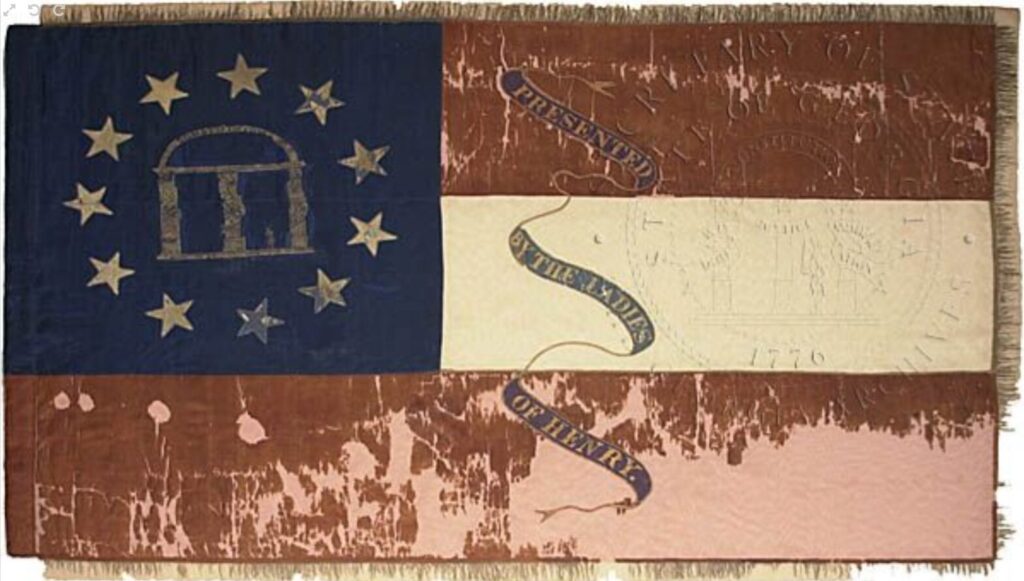
27th Georgia Infantry Regiment, Company H, Zachary Rangers Flag

27th Georgia Infantry Regiment, Company H, Zachary Rangers Flag — The 27th Georgia Infantry Regiment, also known as the "Zachary Rangers," was a Confederate Civil War unit formed at Camp Stephens near Griffin, Georgia, in September 1861 and saw action in many battles, including Olustee, Bentonville, and Seven Pines.

Georgia, the Empire State of the South, played a crucial role in the American Civil War. In 1861, the state boasted numerous growing industrial cities such as Atlanta, Augusta, Macon, and Columbus, while coastal Savannah was a prosperous cotton and rice port. During the four years of conflict, Georgia provided the war effort with thousands of troops and vast quantities of food and supplies.

In 1864, the War came to Georgia with Federal troops, marching from their base in Chattanooga, Tennessee, eventually capturing Atlanta and then marching to Savannah, leaving a path of destruction. Many historians consider the loss of Atlanta the final death knell of the Confederacy.

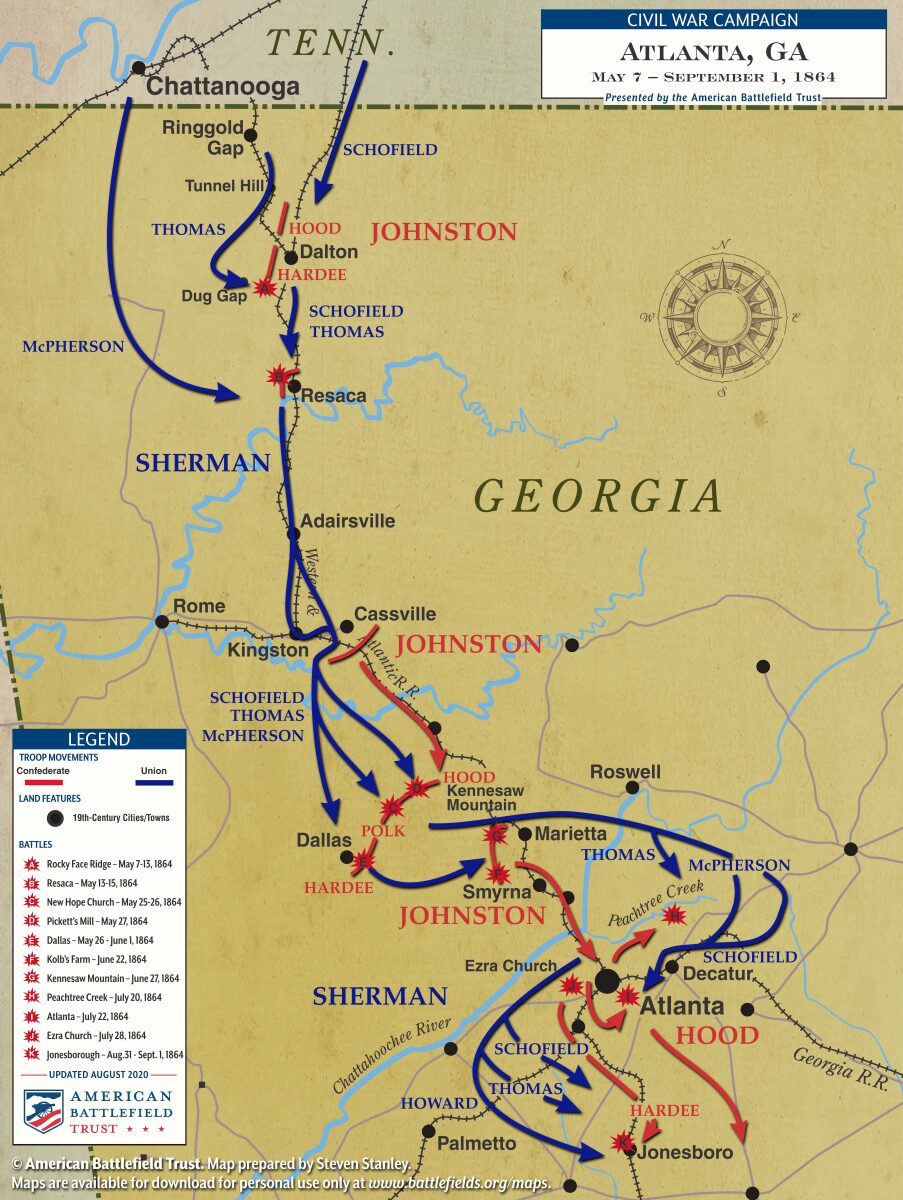
Atlanta Campaign Map

Numerous historical sites associated with the 1864 Atlanta Campaign were lost to development over the last 155 years; however, many were intact and in need of preservation. With this in mind, the Georgia Civil War Commission was formed by the General Assembly in 1993 to coordinate the planning, preservation, and promotion of structures, battlefields, and other sites associated with the Civil War that are not already managed by the state or federal government. The Commission comprises fifteen volunteers appointed by the Governor, Lieutenant Governor, and Speaker of the Georgia House of Representatives.

Key Preservation Victories

An early victory for the Georgia Civil War Commission was the Battlefield at Griswoldville in middle Georgia, located in Jones and Twiggs Counties. The Commission acquired 17 acres at the site of the only infantry engagement before Union General William T. Sherman arrived in Savannah during the March to the Sea, which is now a state historic site.

From its inception, the Georgia Civil War Commission focused on preserving the Battlefield at Resaca, where Sherman and Joseph E. Johnston's troops collided in May 1864 in the first significant engagement of the Atlanta Campaign. In May 2000, the state purchased a 508-acre tract of that battlefield for $2.36 million — a major Civil War preservation victory, with the Commission being a key player in facilitating the sale.

Additionally, the Commission played a vital role in preserving a 190-acre tract of land in southwest Atlanta adjacent to Utoy Creek, which was on the Civil War Preservation Trust's Ten Most Endangered Battlefields. Throughout the property, trenches dug by Union Gen. John Palmer's XIV Corps in August 1864 during the siege of Atlanta are visible.

In 2001, the Commission began negotiations with the landowner, Cascade Properties, to save the property. With philanthropic help from the Arthur Blank Family Foundation, the Georgia Greenspace Program, the City of Atlanta Greenway Acquisition Project, and the Quality-of-Life Improvements Bond Project, the Georgia Civil War Commission facilitated the purchase of the land for the City of Atlanta for $2.65 million. Plans for the site — a heavily wooded parcel surrounded by a residential area — include trails and interpretive signs.

Nash Farm Battlefield at Sunrise
by Duckworth Photography

When development threatened 208 acres of pristine battlefield associated with Kilpatrick's Raid, the Georgia Civil War Commission worked with individuals, Henry County Commissioners, the American Battlefield Trust, and the Georgia Battlefield Association to save the property. In 2006, once the property was secured, the Commission helped place interpretive signs and groom the once-family farm into a tourist attraction. Nash Farm Battlefield Park became a historical gem south of Atlanta.

Education & Publications

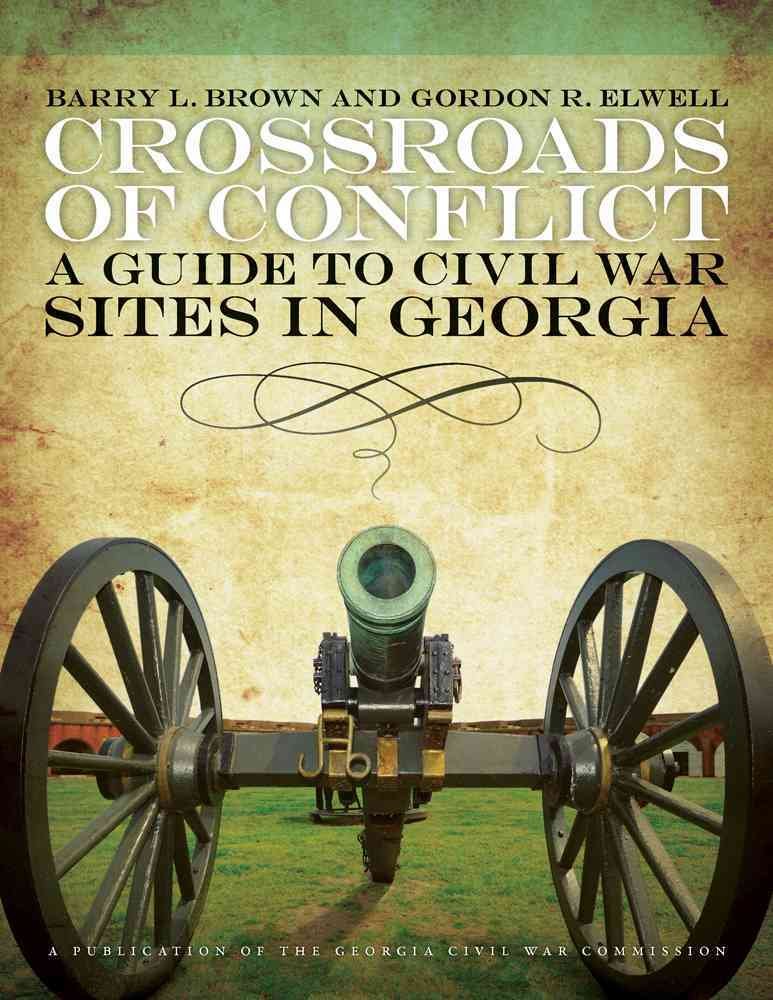
Crossroads of Conflict book cover
Crossroads of Conflict — co-published with the University of Georgia Press

In 2010, the Georgia Civil War Commission co-published a revised edition of Crossroads of Conflict, a detailed guidebook to the state's Civil War sites, with the University of Georgia Press, the Georgia Department of Economic Development, and the Georgia Humanities Council. During the Sesquicentennial, the Commission published a booklet entitled Georgia's Confederate Counties, telling the history of counties whose namesake played a role in the War Between the States. Creating a poster of the "Great Locomotive Chase" was one of the ways the Commission assisted teachers in bringing history to the classroom during the Sesquicentennial. Reprinting the Centennial maps of the Battle of Atlanta and Georgia was another project the Commission undertook.

With the spotlight on Georgia and the entire South during the 150th anniversary of the American Civil War, the Georgia Civil War Commission partnered with different organizations and groups to showcase this period's history. Re-enactments, educational symposiums, government proclamations, and placing interpretive signs in communities across the state are some ways the Commission remembered this key anniversary.

Honoring the Enslaved

The Georgia Civil War Commission funded Ground Penetrating Radar studies to locate unmarked graves in many different locations, including the District Hill Slave Cemetery south of Chickamauga — to increase public awareness of the impact of enslaved people who, despite the conditions and circumstances of the era, lived, labored, and died for the betterment of others' lives.

Heritage Tourism & Community Partnerships

Drummer Boy Civil War Museum
The Drummer Boy Civil War Museum facelift project the Georgia Civil War Commission sponsored

In over 30 years of existence, the Georgia Civil War Commission has worked alongside local museums, partnering to bring the rich history of this time period alive for tourists. Heritage tourism impacts Georgia's economy, and the Commission wants to assist these entities in retelling the various stories of Georgia and its residents. Some of the more renowned ones are Oakland Cemetery and the Georgia Capitol Museum Hall of Valor. Still, the smaller gems are the Drummer Boy Museum in Andersonville, Tunnel Hill Heritage Center in Dalton, and Crawford Long Museum in Jefferson.

With Heritage Tourism a key factor for Georgia's tax base, the Georgia Civil War Commission has partnered with local governments and non-profits to place markers denoting the history of events or individuals throughout the state. Many of these signs can be found on this website. The most distinguished current project of the Commission is the Chickamauga Campaign Heritage Trail — the elements of nature have caused damage and age to the wayside markers' sign panels, so the Commission is replacing them for future generations.

Education Initiatives

In the field of education, the Georgia Civil War Commission sponsored educational symposiums, as well as maps and classroom resources to assist teachers with students of all ages. The Commission partnered with Kennesaw State University's Center for the Study of the Civil War Era to bring Collectors' Showcases, leadership symposiums, and educational symposiums. The Commission supported the research of primary sources to continue to learn and explore the plethora of perspectives and unknown documentation.

The Georgia Civil War Commission continues to sponsor and host national conferences, education forums, and preservation forums and to network with local, state, and national preservation groups. Commissioners are regularly asked to endorse preservation efforts and speak at meetings and lectures.

Home / About Us / Commissioners

Our Commissioners

Fifteen dedicated volunteers appointed to serve and steward Georgia's Civil War heritage — without compensation, driven by a shared passion for preserving history.

The Commission comprises fifteen volunteers appointed by the Governor, the Lieutenant Governor, and the Speaker of the Georgia House of Representatives. Commissioners represent diverse backgrounds and regions across the state, united by their commitment to Civil War preservation and education.

John Culpepper
Chair

John Culpepper

Lt. Governor Appointment
Chickamauga, GA
View Bio →
Kelly Charles Barrow
Vice Chair

Kelly Charles Barrow

Lt. Governor Appointment
Griffin, GA
View Bio →
Inger Eberhart
Treasurer

Inger Eberhart

House Speaker Appointment
Canton, GA
View Bio →
James Yancey Jr.
Secretary

James Yancey, Jr.

Lt. Governor Appointment
Evans, GA
View Bio →
Curt Harris Collier III
Commissioner

Curt Harris Collier, III

Governor Appointment
Athens, GA
View Bio →
Karen T. Ledford
Commissioner

Karen T. Ledford

Lt. Governor Appointment
Toccoa, GA
View Bio →
J.H. Segars
Commissioner

J.H. Segars

Lt. Governor Appointment
Madison, GA
View Bio →

Chief of Staff

Cassie Barrow
Georgia Civil War Commission
cbarrow@georgiacivilwar.org
Home / Online Research Repositories

Online Research Repositories

Curated digital archives, collections, and research tools for students, educators, and researchers exploring the Civil War in Georgia.

Alexander H. Stephens Papers

The papers of Alexander Hamilton Stephens (1812–1883) — lawyer, journalist, Governor of Georgia, member of both houses of the United States Congress, and Vice President of the Confederate States of America — span the years 1784–1886, with the bulk of the material concentrated in the period 1850–1883. The collection consists primarily of correspondence, supplemented by an autobiography, journal, miscellaneous memoranda, legal documents, and clippings. The papers are organized into three series: General Correspondence, Letters from Servants, Autobiography, and Journal.

Visit Repository at loc.gov →

American Battlefield Trust

The American Battlefield Trust preserves America's hallowed battlegrounds and educates the public about what happened there and why it matters. The education team offers various resources for teachers and students, from continuing education credits to curricula and lesson plans, from research guides to scholarships and contests.

Visit Repository at battlefields.org →

Civil War History — Georgia Historical Society

More than 5 million items document over 300 years of Georgia and American history, from the colonial period through the 21st century. These include 100,000 photographs, 30,000 architectural drawings, 20,000 rare and non-rare books, and thousands of maps, portraits, and artifacts. Use these tools to search the Georgia Historical Society collections.

Search the GHS Collections →

Documenting the American South

Documenting the American South (DocSouth) is a digital publishing initiative sponsored by the University Library at the University of North Carolina at Chapel Hill. It provides access to digitized primary materials that offer Southern perspectives on American history and culture, supplying teachers, students, and researchers at every educational level with a wide array of titles for reference, studying, teaching, and research.

Visit DocSouth at unc.edu →

Documenting the Civil War Experience in Georgia

Archival materials documenting the Atlanta Campaign and the defense of Savannah; the Eastern and Western Theaters; Confederate government records; life on the home front; slavery; and the Civil War in memory. Records include the diverse experiences of military leaders, soldiers, and civilians. Thousands of first-hand accounts of Union and Confederate soldiers document their hardships and opinions of the war. Military documents, including orders issued by William T. Sherman, describe the strategy of the Atlanta Campaign. Letters and diaries from Georgia civilians describe the anxiety leading up to the war, the blockade of Georgia's coast, the siege of Atlanta, and Sherman's march through Georgia.

Visit the Digital Library of Georgia →

Georgia Military Units

Most units were numbered; however, some were named. See the table in the link for lists of the regiments, battalions, batteries, and other units that served Georgia during the Civil War. The Georgia Military Units list information comes from the Civil War Soldiers and Sailors website, which can also be searched by a soldier's name.

Search Georgia Military Units →

Military History — Atlanta History Center

The Kenan Research Center's military history collections document the Civil War, particularly the Atlanta Campaign of 1864, and the experiences of Georgia soldiers involved in other theaters of battle. The Research Center's holdings include over 350 primary source materials, including diaries, letters, military orders, and other materials from Union and Confederate soldiers, officers, and civilians.

Visit the Kenan Research Center →
New Georgia Encyclopedia

The New Georgia Encyclopedia (NGE) is the nation's first born-digital state encyclopedia. Since 2004, it has provided ready access to authoritative scholarship on various topics. All entries are written and reviewed by scholars, fact-checked by reference librarians at the University of Georgia, and updated regularly to reflect new information and recent developments. Nearly twenty years after its launch, the NGE remains committed to the notion that history and culture are public resources that should be freely available to one and all.

Visit the New Georgia Encyclopedia →

Virtual Vault — Georgia Capitol Flag Collection

In 1905, Georgia Governor Joseph Terrell announced that the U.S. War Department had returned twenty-six Civil War flags to Georgia. He requested state funds to preserve the collection. In 1916, the General Assembly mandated that the flags from the Civil War and Spanish-American War "be preserved for all time in the Capitol of the State." The law required the governor to accept "any such flag offered to the State" and "to make such provision for its preservation as may be necessary." Thus began the Georgia Capitol flag collection, which can be viewed in this Virtual Vault.

Browse the Virtual Vault →
Home / Civil War in Georgia / Timeline

The Civil War in Georgia

A brief summary of principal events, 1861–1865.

1861
Ordinance of Secession, Georgia, January 19, 1861

Republic of Georgia. Ordinance of secession, passed January 19, 1861, with the names of the signers. An ordinance to dissolve the Union between the State of Georgia and the other States united with her under the compact of government entitled "The Constitution of the United States of America."

January 1, 1861
Georgians go to the polls to vote on either a pro-Union or pro-Secession slate of delegates for the state convention to be held in Milledgeville. The referendum is won by the pro-Secession vote.
January 3, 1861
Georgia militia under General Francis Bartow seizes Federal government property, including Fort Pulaski.
January 19, 1861
Georgia votes to leave the Union at the Secession Convention in Milledgeville.
January 22, 1861
A "statement of protest" is issued by the six convention delegates who refused to sign the Ordinances of Secession.
September 11, 1861
Joseph E. Brown is elected to a third term as governor.
1862
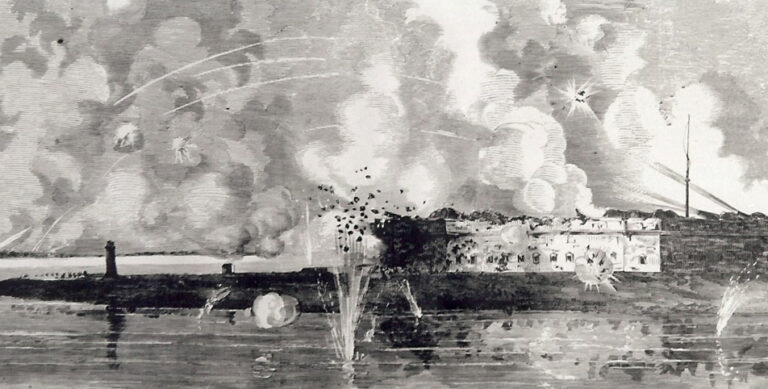
The bombardment of Fort Pulaski, April 1862

The bombardment of Fort Pulaski — Second day, Friday, April 11, 1862. "Fort Pulaski Under Fire," April 1862, Frank Leslie's Weekly Magazine. View of Union bombardment from the North Channel of the Savannah River, northeast of the fort. The southeast corner has brick and mortar blasted into the air by conical high explosive shells from five Parrott Rifle cannons in Battery Sigel, Tybee Island, Georgia.

February 10, 1862
General Robert E. Lee requests permission from Governor Joseph E. Brown to dismantle the Confederate batteries on Jekyll Island as the inhabitants had abandoned the island. The guns are sent to strengthen the defenses around Savannah.
March 9, 1862
Federal troops occupy Jekyll Island.
April 10–11, 1862
The Battle of Fort Pulaski occurs. Areas of the fort are reduced to rubble by the use of rifled cannons by the Federals under Brigadier General Quincy A. Gillmore, thus forever ending the era of the masonry fort.
April 12, 1862
Union raiders in civilian clothing seize the Confederate engine General at Big Shanty on a mission of sabotage. The plot falls apart due to rain, poor decision-making, and a tenacious band of Confederates in hot pursuit. The raiders were captured but later received the first Medals of Honor (some posthumously) bestowed by the U.S. Government.
July 1862
The Griswold Cotton Gin Company produces their first Colt-patterned revolvers under a Confederate contract.
July 1, 1862
Federal Navy assault on Fort McAllister.
July 29, 1862
Federal Navy assaults Fort McAllister.
1863
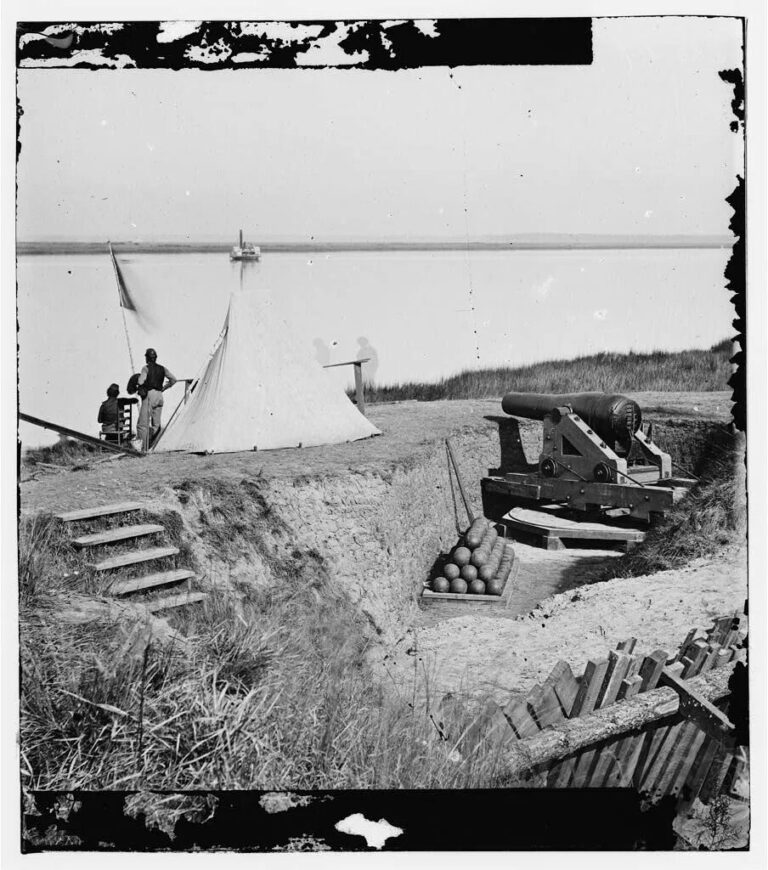
A signal station on the Ogeechee River at Fort McAllister

A signal station on the Ogeechee River at Fort McAllister. After General William T. Sherman's Union troops occupied Fort McAllister on December 13, 1864, personnel were ordered to dismantle the stronghold in preparation for Sherman's march northward.

January 27, 1863
Federal Navy assaults Fort McAllister.
February 28, 1863
Federal gunships including the Monitor U.S.S. Montauk move up the Ogeechee River past Fort Pulaski to destroy the Confederate privateer Rattlesnake (formerly Nashville).
March 3, 1863
Federal Naval assaults on Fort McAllister resume.
May 3, 1863
Confederate General Nathan Bedford Forrest captures Colonel Abel Streight's raiders in western Alabama before they reach their goal of Rome, Georgia.
June 11, 1863
The coastal town of Darien is burned by the USCT of the 54th Massachusetts Infantry Regiment.
September 19–20, 1863
The Battle of Chickamauga ends in Confederate victory and leads to the siege of Chattanooga.
October 10, 1863
Jefferson Davis arrives in north Georgia to visit Army of Tennessee commander General Braxton Bragg and to mediate a growing feud between Bragg and his generals.
November 27, 1863
Federal pursuit of the Confederate Army of Tennessee fleeing Chattanooga is stopped by the ambuscade under Major General Patrick Cleburne at the Battle of Ringgold Gap.
December 16, 1863
Confederate General Braxton Bragg resigns command of the Army of Tennessee and is replaced by General Joseph E. Johnston at Dalton. The Army of Tennessee spends the winter of 1863–64 headquartered at Dalton.
1864
Georgia in the Civil War Poster
January 2, 1864
Major General Patrick Cleburne presents a proposal to the Army of Tennessee high command to offer freedom to enslaved people who would volunteer to fight for the Confederate army. A topic of great controversy, the proposal — presented at the Dr. James Black house in Dalton — never got off the ground.
February 22–27, 1864
General George Thomas probes Confederate lines around Dalton after General Joseph E. Johnston dispatched two divisions to aid Lt. General Leonidas Polk in the West. Thomas withdrew on February 27 after realizing Johnston could counter any Federal threat.
May 5–7, 1864
The Atlanta Campaign begins as the Federal XIV Corps drives the Confederate outpost from Tunnel Hill to Buzzard's Roost.
May 8–11, 1864
The Battles of Rocky Face Ridge and Dug Gap occur while Federal troops probe Buzzard's Roost Gap in unsuccessful attempts to dislodge the Confederates.
May 8–13, 1864
General James B. McPherson attempts a flanking movement around Confederate forces at Dalton through the Snake Creek Gap — establishing the pattern for the entire campaign. The plan was to get between the Confederate Army and Atlanta at Resaca. A small force of Confederates stationed at Resaca causes McPherson to hesitate and lose the advantage.
May 14–15, 1864
The Battle of Resaca ends in a draw but the Confederate Army is forced to head south to protect its flanks.
May 16, 1864
Battle of Rome Crossroads and fighting near Calhoun.
May 17, 1864
Fighting at Adairsville and in the vicinity of Rome.
May 18–19, 1864
General Johnston's attempted assault on a portion of General Sherman's pursuing forces at Cassville falls short when Lt. General John B. Hood, fearing a threat on his flank, fails to act.
May 20, 1864
The Etowah River is crossed as the Federal Army moves ever closer to Atlanta. However, General Sherman, wishing to avoid a frontal assault on well-entrenched Confederates in the Allatoona Mountain range, leaves the railroad and attempts to flank Johnston to the west.
May 25, 1864
The Battle of New Hope Church occurs after Confederates rush west into Paulding County to meet General Sherman's threat there. Heavy casualties result after two hours of fighting stops the Federal advance.
May 26–June 1, 1864
Fighting on the New Hope–Dallas line in Paulding County as the Atlanta Campaign becomes a war of entrenchment.
May 27, 1864
A Federal flanking movement is stopped with heavy casualties at the Battle of Pickett's Mill.
June 14, 1864
Lt. General Leonidas Polk is killed atop Pine Mountain.
June 9–23, 1864
Operations west of Marietta including fighting at Pine Mountain, Lost Mountain, Brushy Mountain, Gilgal Church, Mud Creek, Noonday Creek, and Noyes Creek. The Confederates are forced back to the "Gibraltar of Georgia" — the Kennesaw Mountain Line.
June 22, 1864
At the Battle of Kolb's Farm, Hood's assaults are all stopped with a bloody repulse, though the Federal flanking movement around Kennesaw Mountain is temporarily averted.
June 27, 1864
The Federals launch a morning assault on what are considered weak points in the Confederate line and are repulsed at all points with heavy losses at the Battle of Kennesaw Mountain.
July 3–4, 1864
The Confederate army abandons the Kennesaw line to avoid a Federal flanking movement and moves back to the Smyrna–Ruff's Mill Line. Federals assault the line at both Smyrna Station and Ruff's Mill.
July 5–9, 1864
Johnston's River line is occupied. The Federals build a parallel line and constant skirmishing ensues.
July 5–17, 1864
Operations along the Chattahoochee River with fighting at Howell's, Turner's, and Pace's Ferries.
July 18, 1864
General Joseph E. Johnston, after having failed to stop the Federal advance towards Atlanta, is relieved of command by President Jefferson Davis and replaced by Lt. General John B. Hood.
July 18–20, 1864
Operations commence around Peachtree Creek, including fighting at Moore's Mill, Green Bone Creek, and east of the city at Stone Mountain.
July 20, 1864
The Battle of Peachtree Creek is the first of Hood's three unsuccessful sorties during July, designed to piecemeal destroy elements of Sherman's army.
July 21, 1864
Combat for control of Leggett's Hill.
July 22, 1864
The Battle of Atlanta and the Battle of Decatur. Federal Major General James B. McPherson and Confederate Major General W.H.T. Walker are killed.
July 22–24, 1864
Federal General Kenner Garrard's cavalry raids Covington.
July 23–August 26, 1864
Siege operations begin and last through most of August.
July 27–31, 1864
Brigadier General Edward McCook leads a cavalry raid on the Atlanta & West Point and Macon & Western Railroads.
July 28, 1864
The Battle of Ezra Church.
July 30, 1864
Battle at Dunlap Farm and shelling of Macon by Stoneman's raiders.
July 31, 1864
Battle of Sunshine Church. Major General George Stoneman and 600 men surrender to Confederate Brigadier General Albert Iverson.
August 3, 1864
Battle of King's Tanyard.
August 5–7, 1864
Battle of Utoy Creek. Fighting around Atlanta's West End.
August 10–September 9, 1864
Confederate General Wheeler's cavalry raids into North Georgia and East Tennessee.
August 18–22, 1864
Federal General Judson Kilpatrick's raid on Lovejoy Station.
August 31–September 1, 1864
Battle of Jonesboro. General Hood's 80 railroad cars of munitions are exploded.
September 2, 1864
Federal troops occupy Atlanta.
September 25, 1864
President Jefferson Davis visits General Hood's headquarters at Palmetto to confer on the military situation after the fall of Atlanta.
September 28, 1864
President Jefferson Davis wires Hood from West Point, GA to relieve Lt. General Hardee from the Army of Tennessee and send him to command the Department of South Carolina, Florida, and Georgia. Hardee's new assignment would be headquartered in Savannah.
October 5, 1864
Following several days' march north from Palmetto, General Hood dispatches Major General French's division to capture the Federal garrison at Allatoona Pass. After severe combat, the French withdraw without the garrison's capitulation.
November 8, 1864
Lincoln is reelected as President of the United States.
November 15, 1864
Major General W.T. Sherman, after organizing his army into a right wing and a left wing, begins his double-pronged march across Georgia from Atlanta to Savannah. All items of use to the Confederates in Atlanta are burned.
November 19, 1864
Governor Joe Brown calls for all men between the ages of sixteen and fifty-five to oppose Sherman, but is unable to raise a significant force.
November 22, 1864
The Battle of Griswoldville ends in Confederate defeat. The state capitol at Milledgeville falls to the Federal invaders.
November 28, 1864
Cavalry action at Buckhead Creek and Reynolds Plantation.
December 4, 1864
The Battle of Waynesboro.
December 7, 1864
The Ebenezer Creek incident occurs at the Augusta/Savannah causeway crossing.
December 13, 1864
Fort McAllister falls, leading to the evacuation of Savannah.
December 16, 1864
Doctortown, on the Altamaha River, is successfully defended against several Federal assaults.
December 20–21, 1864
The City of Savannah falls to the invading Federals while Lt. General Hardee's army escapes into South Carolina.
1865
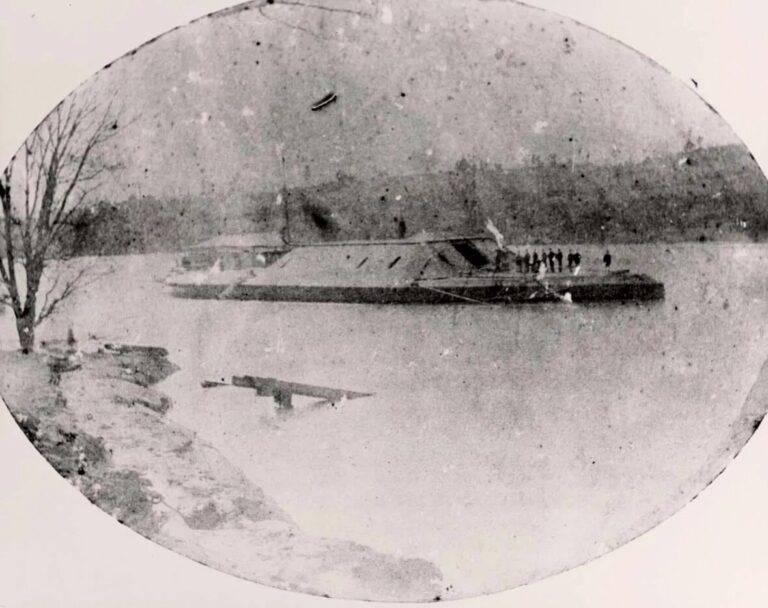
The CSS Jackson, Columbus, Georgia

The CSS Jackson was the last ironclad constructed for the Confederate Navy in Columbus, Georgia. It was never deployed and was burned by Federal forces under General James H. Wilson during the Battle of Columbus on April 16, 1865. Courtesy of the Naval History and Heritage Command.

April 16, 1865
Brigadier General James H. Wilson's Federal raiders enter Georgia and attack at West Point and Columbus. The Battle of West Point ends with the fall of Fort Tyler and the death of Brigadier General Robert C. Tyler. Columbus is captured and its naval works are burned, along with the ship CSS Jackson.
May 10, 1865
Confederate President Jefferson Davis is captured near Irwinville.
May 12, 1865
Confederate Brigadier General William T. Wofford surrenders the last significant body of Confederate troops in Georgia to the Federals, ending the war in Georgia.
Home / Historical Places

Historical Places

Discover Civil War heritage across Georgia's seven distinct tourism regions — each with its own remarkable story from the War Between the States.

Map of Georgia's Civil War Heritage Regions

Georgia's Tourism Regions — ExploreGeorgia.org

About the Regions

Georgia's Civil War Heritage, Region by Region

The Civil War touched every corner of Georgia — from the mountain gaps of the northwest where the Atlanta Campaign began, to the Sea Islands of the coast where the war arrived by water as early as 1861. The map to the left shows Georgia's seven tourism regions, each of which contains significant Civil War sites, battlefields, museums, cemeteries, and historic homes.

The Historic High Country of northwest Georgia — covering Catoosa, Walker, Whitfield, Gordon, Floyd, and neighboring counties — is the most densely concentrated area of Civil War history in the state, encompassing the entire Atlanta Campaign corridor from Ringgold to Kennesaw.

Select a region below to explore historic sites, battlefields, and points of interest. Content from Crossroads of Conflict: A Guide to Civil War Sites in Georgia is being digitized region by region.

⛰️

Historic High Country

Where the Atlanta Campaign began — Tunnel Hill, Dalton, Resaca, Chickamauga, Ringgold, and Rome across northwest Georgia.

⚑ Explore 50+ Sites →
🌲

Northeast Georgia Mountains

Home of General James Longstreet, mountain Unionism, and stunning landscapes — Gainesville, Dahlonega, and the Blue Ridge highlands.

⚑ Explore Sites →
🏙

Atlanta Metro

Kennesaw Mountain, Battle of Atlanta, Utoy Creek, Peachtree Creek, and Jonesboro — the heart of the 1864 campaign.

⚑ Explore Sites →
🏛

Presidential Pathways

Presidential homes, Andersonville Prison, and the National Civil War Naval Museum — west-central Georgia's remarkable Civil War story.

⚑ Explore Sites →
🌾

Historic Heartland

Antebellum grandeur, Georgia's wartime capital, and the path of Sherman's March — Madison, Milledgeville, Macon, and beyond.

⚑ Explore Sites →
🏛

Classic South

Antebellum grandeur, Augusta's Confederate industries, and Washington-Wilkes — where Jefferson Davis held the last Cabinet meeting of the Confederacy.

⚑ Explore Sites →
🌿

Magnolia Midlands

Where Jefferson Davis was captured, where Doctortown held firm against Sherman, and where the final chapter of the Confederacy was written.

⚑ Explore Sites →
🌱

Plantation Trace

The "breadbasket of the Confederacy" — southwest Georgia's vast agricultural lands that fed the Southern war effort from Albany to Thomasville.

⚑ Explore Sites →
🌊

Georgia's Coast

Intense naval warfare — from the bombardment of Fort Pulaski to the fall of Savannah in December 1864.

⚑ Content Coming Soon
Home / Historical Places / Classic South

Classic South

Antebellum grandeur, Confederate industry, and pivotal wartime events across east-central Georgia — from Augusta to Washington-Wilkes.

The Classic South region of Georgia shares a picturesque charm with the Historic Heartland, showcasing an abundance of antebellum homes that evoke the elegance and grandeur often associated with the "Gone With the Wind" tradition. This area, particularly around Washington-Wilkes, is known for its well-preserved architecture, historic sites, and picturesque landscapes that transport visitors back to the antebellum era.

Another significant historical aspect of the Classic South is Augusta, which played a vital role during the Civil War. As a bustling Confederate city and a critical railroad junction, Augusta was strategically important for transporting troops and supplies. Furthermore, it was home to the second-largest armament factory in the world at the time, where a variety of munitions were produced to support the Confederate war effort. The factory's presence contributed to the war and shaped the city's economy and infrastructure during that period.

The Classic South region combines a wealth of antebellum architecture, significant Civil War history, and vibrant Southern culture, making it an enriching and captivating destination for history buffs and casual travelers alike.

Augusta Washington Crawfordville Waynesboro Louisville Sandersville

Augusta

Richmond County

Augusta was one of the most important Confederate cities in Georgia — a railroad hub, a home front industrial center, and a major hospital city. Located along the Savannah River with rail connections in every direction, Augusta was strategically vital for moving troops and supplies throughout the Confederacy. Its industrial capacity made it a cornerstone of Confederate war production.

⚙️

Confederate Powder Works

The Confederate Powder Works was the second-largest gunpowder manufacturing facility in the world at the time of its operation — producing more than 2.75 million pounds of gunpowder for Confederate armies over three years. Built along the Augusta Canal under the direction of Colonel George Washington Rains, the facility stretched nearly two miles along the canal. The only surviving structure is the 176-foot-tall Chimney, which stands today as a monument to the Confederate dead.

Learn More →
🌊

Augusta Canal & Heritage Area

The Augusta Canal, completed in 1845, powered Augusta's industrial growth before and during the Civil War. The canal's mills and factories produced textile goods, flour, and — crucially — gunpowder for the Confederate war effort. Today the Augusta Canal National Heritage Area preserves this remarkable industrial corridor. Boat tours along the canal offer a unique perspective on Augusta's wartime industrial landscape.

Visit Augusta Canal →
🏛

Augusta Museum of History

The Augusta Museum of History houses extensive collections documenting Augusta's role in the Civil War, including the Confederate Powder Works, the city's military hospitals, and the home front experience. The museum's Civil War galleries provide rich context for understanding Augusta's strategic importance to the Confederacy and the daily lives of its citizens during the conflict.

Learn More →
🚂

Augusta Railroad Connections

Augusta's position at the intersection of several rail lines made it a critical Confederate logistics hub. The Georgia Railroad connected Augusta to Atlanta, while the South Carolina Railroad linked it to Charleston. These connections allowed Augusta to serve as a major distribution point for troops, supplies, and the enormous output of the Confederate Powder Works throughout the war.

⚰️

Magnolia Cemetery

Augusta's historic Magnolia Cemetery contains the graves of hundreds of Confederate soldiers, including many who died in Augusta's numerous military hospitals during the war. Established in 1818, the cemetery's Confederate section includes a monument to the Confederate dead and provides a solemn record of the city's wartime sacrifice.

🏥

Confederate Military Hospitals

Augusta served as a major Confederate hospital city throughout the war. The Medical College of Georgia provided facilities and staff, while several large military hospitals operated throughout the city, treating thousands of wounded soldiers from campaigns across the Deep South and the Atlanta Campaign. The city's rail connections made it an ideal location for receiving and distributing the wounded.

Washington

Wilkes County

Washington-Wilkes is perhaps the most historically significant town in the Classic South for Civil War history. It was here, in May 1865, that Jefferson Davis held the last meeting of the Confederate Cabinet and where the Confederacy's treasury began its final, desperate journey south. The town is also celebrated for its remarkable collection of antebellum architecture, making it one of the finest intact antebellum communities in Georgia.

🏛

Washington Historical Museum

The Washington Historical Museum houses an impressive collection of Civil War artifacts, including items related to Jefferson Davis's flight through Washington and the last meeting of the Confederate Cabinet. The museum interprets Washington's role in the final days of the Confederacy and the town's rich antebellum heritage through artifacts, documents, and photographs.

Learn More →
🏠

Robert Toombs House State Historic Site

The home of Robert Toombs — one of Georgia's most prominent antebellum politicians, a U.S. Senator, and the first Confederate Secretary of State — stands as a beautifully preserved historic site in Washington. Toombs remained defiant after the war, famously refusing to seek a pardon. He escaped to Europe before returning to Georgia, living in this house until his death in 1885.

Georgia State Parks →
🏛

Last Confederate Cabinet Meeting Site

On May 5, 1865, Jefferson Davis held the last formal meeting of the Confederate Cabinet at a private home in Washington. Davis and the remnants of the Confederate government were fleeing southward following the fall of Richmond and Lee's surrender at Appomattox. The Washington meeting was one of the final acts of the Confederate government before its complete dissolution.

🌳

Antebellum Architecture & Historic District

Washington's historic district is one of the finest collections of antebellum architecture in Georgia — remarkable for its survival largely intact through the Civil War and beyond. The town was spared significant destruction during Sherman's campaigns, preserving Greek Revival, Federal, and Victorian homes that represent the elegance of Georgia's pre-war plantation society.

Crawfordville

Taliaferro County

Crawfordville is home to Liberty Hall, the antebellum home of Alexander H. Stephens — Vice President of the Confederate States of America, former U.S. Congressman, and later Governor of Georgia. Stephens was one of the most complex and conflicted figures of the Confederate era, having opposed secession before ultimately serving the Confederacy he had spoken against.

🏛

Liberty Hall State Historic Site

Liberty Hall was the home of Alexander H. Stephens, Vice President of the Confederate States of America. The house has been carefully preserved and restored to its Civil War-era appearance, with original furnishings and personal artifacts. The adjacent Confederate Museum houses one of Georgia's finest collections of Confederate artifacts, flags, weapons, and personal effects. Together they offer an intimate look at the life of one of the Confederacy's most important — and most conflicted — leaders.

Georgia State Parks →
⚰️

Confederate Museum at Liberty Hall

Adjacent to the Liberty Hall home, this museum houses one of Georgia's most significant collections of Confederate artifacts and memorabilia, including flags, weapons, uniforms, and personal effects of Confederate leaders and soldiers. The museum places Alexander Stephens's story within the broader context of Georgia's Civil War experience.

Georgia State Parks →

Waynesboro

Burke County

Waynesboro witnessed one of the final cavalry engagements of Sherman's March to the Sea — the Battle of Waynesboro on December 4, 1864, in which Union General Judson Kilpatrick's cavalry clashed with Confederate General Joseph Wheeler's horsemen in a sharp engagement that covered the Union army's flanking movements toward Savannah.

⚔️

Battle of Waynesboro

The Battle of Waynesboro (December 4, 1864) was one of the significant cavalry engagements of Sherman's March to the Sea. Union General H. Judson Kilpatrick's cavalry force, after feinting toward Augusta to confuse Confederate defenders, engaged Confederate cavalry under General Joseph Wheeler at Waynesboro. The engagement scattered Wheeler's forces and cleared the way for Sherman's continued advance toward Savannah.

⚰️

Burke County Confederate Cemetery

Waynesboro's Confederate cemetery holds the remains of soldiers who died in the area during the Civil War, including casualties from the Battle of Waynesboro. Burke County contributed significantly to the Confederate military effort, and the cemetery serves as an important memorial to the county's wartime sacrifice.

Louisville

Jefferson County

Louisville — one of Georgia's earliest capitals — lay directly in the path of Sherman's March to the Sea. Federal forces passed through Jefferson County in November 1864, foraging off the land and destroying anything of military value. The town's connections to Georgia's early political history make it an important stop on any heritage tour of the Classic South.

🏛

Old Market House

Louisville's historic Old Market House, a landmark of Georgia's early capital city, survived the Civil War period and stands today as one of the state's oldest public buildings. The building witnessed the transition of Louisville from Georgia's seat of government to a small agricultural county seat — and the difficult years of the Civil War and Reconstruction.

🚶

Sherman's March through Jefferson County

In November 1864, elements of Sherman's army passed through Jefferson County during the March to the Sea. Federal foragers — known as "bummers" — spread across the county collecting food and livestock and destroying anything of military value. The experience of Sherman's march through this region is documented in several period diaries and letters from local residents.

Sandersville

Washington County

Sandersville sat directly on the path of Sherman's March to the Sea in November 1864. The town experienced Federal occupation and the burning of much of its downtown, making it one of the Classic South communities most directly affected by the March. Washington County's wartime experience offers a vivid illustration of the March's impact on Georgia's civilian population.

🔥

Sandersville & the March to the Sea

Sandersville was occupied by Federal troops on November 26, 1864, as Sherman's army passed through Washington County. A portion of the town was burned in retaliation for Confederate sniping on Union forces. The town's experience — including accounts left by both Union soldiers and local residents — provides a vivid portrait of life under the March to the Sea.

🏛

Washington County Historical Society

The Washington County Historical Society preserves the records, photographs, and artifacts documenting the county's experience during the Civil War era, including the March to the Sea. Local genealogical and historical resources make Sandersville an important research destination for those tracing ancestors from this part of Georgia.

Home / Historical Places / Atlanta Metro

Atlanta Metro

The heart of the 1864 Atlanta Campaign — Kennesaw Mountain, the Battle of Atlanta, Peachtree Creek, Jonesboro, and a modern city built on hallowed ground.

Atlanta, a city steeped in Civil War history, offers a plethora of sites and attractions that connect visitors to this pivotal era in American history. While many structures from the Civil War period were lost to fires and extensive urban development, significant historical landmarks remain accessible through car and public transportation.

One of Atlanta's most iconic attractions is the Cyclorama, a massive oil painting that vividly depicts the Battle of Atlanta. This immersive artwork, one of the largest of its kind in the world, captures the chaos and intensity of battle, making it a must-see for history enthusiasts.

Nearby, Stone Mountain boasts the world's largest bas-relief sculpture, featuring prominent Confederate leaders carved into the mountain's granite face — a dramatic landmark that highlights artistic achievement and serves as a point of reflection on the complexities of the Civil War and its enduring legacy.

Towns like Roswell, Marietta, Decatur, and Jonesboro are rich with Civil War heritage, as are neighborhoods within Atlanta such as Buckhead, East Atlanta, and West End — each holding stories and sites that commemorate the struggles and triumphs of this era.

Atlanta Kennesaw Marietta Jonesboro Roswell Decatur

Atlanta

Fulton & DeKalb Counties

Atlanta was the prize of the entire 1864 campaign — a railroad hub, manufacturing center, and symbol of Confederate resistance. Its fall on September 2, 1864, secured Lincoln's reelection and effectively sealed the Confederacy's fate. The city was largely burned before Sherman departed on the March to the Sea, yet it rose again — and today preserves some of the war's most remarkable monuments and collections.

🎨

The Cyclorama — Atlanta History Center

The Battle of Atlanta Cyclorama is one of the largest oil paintings in the world — a 42-foot-tall, 358-foot-circumference panoramic painting depicting the Battle of Atlanta on July 22, 1864. Painted between 1885 and 1886 by a team of German artists, it was recently restored to its original splendor and now resides in a custom-built gallery at the Atlanta History Center. The immersive experience places visitors at the center of the battle.

Visit the Cyclorama →
🏛

Atlanta History Center

The Atlanta History Center is home to the Southeast's most extensive Civil War collection — artifacts, exhibitions, personal narratives, and detailed displays that illuminate the war's impact on Atlanta and the South. The Smith Family Farm, an 1860s working farm on the grounds, brings the home front experience to life. The Center's research library holds significant manuscript and photographic collections.

Visit the Center →
⚰️

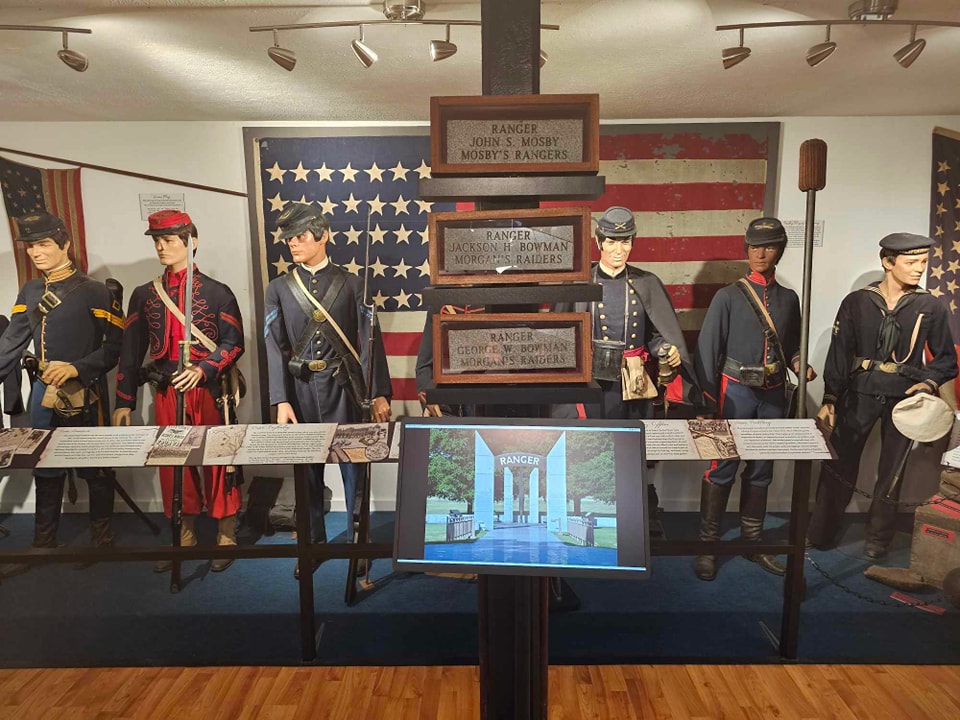
Oakland Cemetery

Oakland Cemetery, established in 1850, is the final resting place of nearly 7,000 Confederate soldiers — the largest Confederate burial ground in Atlanta. The Confederate obelisk and Lion of Atlanta monument honor the fallen. Oakland also contains the graves of six Georgia governors, mayors of Atlanta, and prominent citizens. Guided tours bring the history of Atlanta and the Civil War to life through its remarkable monuments and stories.

Visit Oakland Cemetery →
⚔️

Battle of Atlanta / Leggett's Hill

The Battle of Atlanta (July 22, 1864) was one of the bloodiest engagements of the entire Atlanta Campaign, with approximately 12,000 combined casualties. Fighting raged across what is now the Inman Park and Ormewood Park neighborhoods. The DeKalb Avenue corridor preserves several historical markers, and the Carter Presidential Center area includes interpretive signage related to the battle.

⚔️

Peachtree Creek Battlefield

The Battle of Peachtree Creek (July 20, 1864) was Hood's first major attack after replacing Johnston — an attempt to destroy the Army of the Cumberland as it crossed Peachtree Creek north of Atlanta. Fierce fighting swept through the area near present-day Brookwood Hills and Peachtree Hills. Historical markers along Peachtree Road and the creek corridor commemorate the engagement.

🌲

Utoy Creek Battlefield

The 190-acre Utoy Creek Battlefield in southwest Atlanta — preserved with the support of the Georgia Civil War Commission and the Arthur Blank Family Foundation — contains well-preserved Union earthworks dug by the XIV Corps in August 1864 during the siege of Atlanta. Trails wind through the forested battlefield, and original trench lines remain clearly visible throughout the property.

⛰️

Stone Mountain Park

Stone Mountain Park is home to the world's largest bas-relief sculpture — a carving of Confederate President Jefferson Davis, General Robert E. Lee, and General Stonewall Jackson on the sheer north face of the 825-foot-tall granite mountain. The monument, completed in 1972, stands as a significant — and contested — artifact of Confederate memory in Georgia, provoking ongoing public discussion about the Civil War's legacy.

Visit Stone Mountain Park →
⚔️

Ezra Church Battlefield

The Battle of Ezra Church (July 28, 1864) was Hood's third major attack in nine days — an attempt to stop the Federal advance around Atlanta's west side. Confederate forces suffered approximately 5,000 casualties in a failed assault on a Federal position near present-day Gordon Park in the West End neighborhood. Historical markers in the area commemorate the engagement.

Kennesaw

Cobb County

Kennesaw — known as Big Shanty during the Civil War — was both the starting point of the Great Locomotive Chase (April 12, 1862) and the site of one of the Atlanta Campaign's most dramatic battles. The Kennesaw Mountain National Battlefield Park preserves nearly 3,000 acres of the campaign's most significant terrain.

⚔️

Kennesaw Mountain National Battlefield Park

Kennesaw Mountain National Battlefield Park preserves 2,965 acres of the Atlanta Campaign's most dramatic terrain. The park encompasses the scene of the Battle of Kennesaw Mountain (June 27, 1864) — Sherman's only major frontal assault of the campaign, decisively repulsed by Johnston's entrenched Confederates. Miles of hiking trails, original earthworks, and a visitor center make this one of the best-preserved Civil War landscapes in Georgia.

National Park Service →
🚂

Southern Museum of Civil War & Locomotive History

Home to the original locomotive General — the engine seized by Andrews' Raiders on April 12, 1862, in the Great Locomotive Chase — the Southern Museum offers the nation's finest collection of Civil War railroad history. The museum's exhibits cover both the locomotive history and the broader story of Civil War railroading that made Georgia such a critical theater of operations.

Visit the Southern Museum →

Marietta

Cobb County

Marietta served as a Federal supply base and hospital center during the Atlanta Campaign. The city is home to one of the largest and best-maintained national cemeteries in the South, as well as a significant Confederate cemetery and several museums dedicated to Civil War history and to the cultural legacy of the war's most famous novel.

⚰️

Marietta National Cemetery

Established in 1866, the Marietta National Cemetery is the final resting place of more than 10,000 Union soldiers — many killed during the Atlanta Campaign. The cemetery's carefully maintained grounds, white marble headstones, and reflecting pools provide a solemn and moving tribute to the Federal dead of the campaign. One of the South's largest national cemeteries.

Learn More →
⚰️

Confederate Cemetery

Marietta's Confederate Cemetery holds the remains of approximately 3,000 Confederate soldiers, most of whom died in area hospitals during the Atlanta Campaign. The cemetery was established and maintained by the ladies of Marietta — a community effort that began during the war and has continued for over 150 years. A significant monument at the site honors the Confederate dead.

📚

Gone with the Wind Museum: Scarlett on the Square

Margaret Mitchell's Gone with the Wind — set during the Civil War and Reconstruction in Georgia — remains one of the most widely read novels in American history. This museum on Marietta's historic square houses the largest collection of Gone with the Wind memorabilia in the world, including rare first editions, film costumes, and personal items from the production of the 1939 film.

Visit the Museum →
🏛

Marietta Museum of History

The Marietta Museum of History houses extensive collections documenting Cobb County's role in the Civil War, including the Federal occupation of Marietta and the Atlanta Campaign battles fought in the surrounding county. The museum's research collections are an important resource for genealogists and historians studying the region's wartime experience.

Visit the Museum →

Jonesboro

Clayton County

Jonesboro was the site of the Atlanta Campaign's final battles — the engagement that forced Hood to abandon Atlanta. The Battle of Jonesboro (August 31–September 1, 1864) cut the last rail line supplying the city, making Atlanta's evacuation inevitable. Jonesboro is also celebrated as the setting for Gone with the Wind's fictional Tara Plantation.

⚔️

Battle of Jonesboro Battlefield

The Battle of Jonesboro (August 31–September 1, 1864) was the decisive final engagement of the Atlanta Campaign. Sherman's flanking move against the Macon & Western Railroad — Atlanta's last supply line — forced Hood to abandon the city. Fighting at Jonesboro resulted in approximately 3,000 combined casualties. The battlefield is partially preserved and interpreted through markers and the Road to Tara Museum.

American Battlefield Trust →
📚

Road to Tara Museum

Clayton County is the real-world setting for Margaret Mitchell's fictional Tara — the O'Hara family plantation in Gone with the Wind. The Road to Tara Museum in Jonesboro's historic 1867 train depot interprets the connection between Mitchell's novel and the actual Civil War history of Clayton County, including the Battle of Jonesboro and Sherman's advance through the area.

Visit the Museum →
⚰️

Patrick R. Cleburne Confederate Cemetery

Named for the beloved Irish-born Confederate Major General Patrick R. Cleburne — killed at the Battle of Franklin, Tennessee in November 1864 — this cemetery holds the remains of Confederate soldiers who died in and around Jonesboro during the Atlanta Campaign. Cleburne's body was briefly interred here before being moved to Helena, Arkansas.

Roswell

Fulton County

Roswell witnessed one of the most controversial episodes of the Atlanta Campaign — the arrest and deportation of its mill workers by General Sherman in July 1864. When Federal forces found the Roswell Mills manufacturing Confederate uniforms and cloth, Sherman ordered the mills burned and had the workers — mostly women — arrested and deported north as traitors. Their fate remains largely unknown.

🏭

Roswell Mill Ruins

The ruins of the Roswell Manufacturing Company mills — burned by Sherman's forces in July 1864 — stand along Vickery Creek as a haunting reminder of the war's industrial dimensions. The mill complex employed hundreds of workers, many of them women, who were arrested and deported by Sherman's orders. The ruins are accessible as part of Roswell's historic mill district and adjacent park trails.

Learn More →
🏛

Bulloch Hall

Bulloch Hall, an 1839 Greek Revival plantation home, was the childhood home of Mittie Bulloch — mother of President Theodore Roosevelt and great-grandmother of Eleanor Roosevelt. The home was used as a Federal headquarters during the occupation of Roswell in July 1864. Today it is a beautifully preserved historic house museum offering guided tours that connect visitors to both antebellum Georgia and the remarkable Bulloch family story.

Visit Bulloch Hall →
🏠

Barrington Hall

Barrington Hall is one of the finest examples of Greek Revival architecture in Georgia, built in 1842 by Barrington King, founder of the Roswell Colony and the Roswell Manufacturing Company. The house was used as a Federal headquarters during the Union occupation of Roswell in July 1864 and survived the war largely intact. It stands as a monument to the antebellum prosperity of Roswell's founding families.

Learn More →

Decatur

DeKalb County

Decatur was the site of a sharp cavalry engagement on the same day as the Battle of Atlanta — July 22, 1864. While Sherman's main armies were fighting west of the city, Confederate cavalry under General Joseph Wheeler struck the Federal wagon train and supply depot at Decatur, threatening Sherman's rear before being driven off. Today the town's historic square preserves connections to this dramatic day in Atlanta Campaign history.

⚔️

Battle of Decatur

The Battle of Decatur (July 22, 1864) was fought on the same day as the Battle of Atlanta — a Confederate cavalry raid on the Federal supply train and depot at Decatur, designed to threaten Sherman's rear while Hood's infantry attacked from the west. The Federal wagon train was defended by a small force that held long enough to drive off the Confederate horsemen. Historical markers around Decatur's historic square commemorate the engagement.

🏛

DeKalb History Center

The DeKalb History Center, located in Decatur's 1898 courthouse, houses collections documenting DeKalb County's role in the Civil War, including the Battle of Decatur and the broader Atlanta Campaign. The Center's archives are an important resource for researchers studying the war's impact on the communities east of Atlanta.

Visit the Center →
Home / Historical Places / Presidential Pathways

Presidential Pathways

West-central Georgia — where presidential legacies meet Civil War history, from Andersonville's haunting prison grounds to Columbus's remarkable naval museum.

The Presidential Pathways region of Georgia is a fascinating area that beautifully blends the rich legacies of two U.S. presidents with significant Civil War history. Visitors can explore the homes of presidents Franklin D. Roosevelt and Jimmy Carter, both of whom left profound impacts on American history through their leadership and policies.

A notable historical site within the region is Andersonville Prison, which operated as a Confederate prisoner-of-war camp during the Civil War. Today, it serves as a national historic site and memorial, honoring all prisoners of war across American conflicts — providing visitors with an emotional and educational experience.

The city of Columbus was one of the significant naval construction centers for the Confederacy during the Civil War. The National Civil War Naval Museum at Port Columbus has earned a reputation as a world-renowned repository for Civil War maritime history, showcasing salvaged and preserved vessels and offering a unique perspective on the role of the Navy during the conflict.

The combination of presidential homes, a significant POW memorial, and an extensive naval museum makes the Presidential Pathways region a compelling destination for those interested in American history and the complex narratives surrounding the Civil War.

Andersonville Columbus West Point Warm Springs LaGrange Plains

Andersonville

Sumter County

Andersonville — formally Camp Sumter — was the most notorious Confederate prisoner-of-war camp of the Civil War. Opened in February 1864, it was designed to hold 10,000 Union prisoners but at its peak confined more than 32,000 men in a 26-acre open stockade with almost no shelter, food, or clean water. Nearly 13,000 prisoners died there. Today Andersonville National Historic Site serves as a memorial to all American prisoners of war throughout the nation's history.

🏛

Andersonville National Historic Site

The Andersonville National Historic Site preserves the grounds of Camp Sumter and serves as the only national historic site dedicated to the memory of American prisoners of war from all conflicts. The site includes the reconstructed stockade walls, the original escape tunnels, Providence Spring — the miraculous spring that appeared in response to prisoners' prayers — and the solemn National Cemetery, where nearly 13,000 Union dead are buried.

National Park Service →
🎖

National Prisoner of War Museum

The National Prisoner of War Museum at Andersonville is one of the most powerful and moving museums in the American South. Through first-person accounts, artifacts, and immersive exhibits, the museum honors American prisoners of war from the Revolution through recent conflicts. The Civil War galleries focus on the experience at Camp Sumter, including accounts from survivors and the investigation and trial of Commandant Henry Wirz.

Learn More →
⚰️

Andersonville National Cemetery

The Andersonville National Cemetery holds the remains of nearly 13,000 Union prisoners who died at Camp Sumter — their graves in orderly rows marked by white marble headstones. The cemetery remains an active national cemetery today, with veterans of all eras interred on its grounds. A walk through its rows is among the most sobering Civil War experiences in Georgia.

Learn More →
🥁

Drummer Boy Civil War Museum

The Drummer Boy Civil War Museum in Andersonville village is a charming community gem housing an impressive collection of Civil War artifacts, personal effects, and memorabilia. The museum's passionate volunteers bring the stories of the region's Civil War experience to life in a way that larger institutions sometimes cannot match. The Georgia Civil War Commission has partnered with the museum on several heritage initiatives.

Learn More →

Columbus

Muscogee County

Columbus was one of the Confederacy's most important industrial cities — home to the Confederate Naval Iron Works, textile mills, shoe factories, and weapons manufacturing. The city witnessed the last significant land battle of the Civil War on April 16, 1865 — one week after Lee's surrender at Appomattox — when Union General James H. Wilson's cavalry captured the city and burned its industrial facilities. Today Columbus is home to one of the finest Civil War museums in the country.

National Civil War Naval Museum at Port Columbus

The National Civil War Naval Museum is a world-renowned repository for Civil War maritime history — unique in the country for its collection of actual salvaged Confederate and Union vessels. The museum's centerpiece is the partially reconstructed Confederate ironclad CSS Muscogee, salvaged from the Chattahoochee River. The museum explores naval strategies, technologies, and the role of the Confederate Navy in attempting to break the Union blockade. An extraordinary and often-overlooked treasure of Georgia's Civil War heritage.

Visit the Naval Museum →
⚔️

Battle of Columbus — Last Battle of the Civil War

On April 16, 1865 — one week after Lee's surrender at Appomattox and six days after Johnston's final capitulation — Union General James H. Wilson's cavalry force captured Columbus in what some historians consider the last significant land battle of the Civil War. Confederate defenders made a determined stand at the city's bridges across the Chattahoochee River before being overwhelmed. Wilson's forces burned the city's Confederate naval works, foundries, and warehouses, including the ironclad CSS Jackson.

⚙️

Confederate Naval Iron Works Site

Columbus's Confederate Naval Iron Works was one of the most significant manufacturing facilities in the Confederacy — producing cannons, armor plating, and naval hardware for Confederate warships. The works were burned by Wilson's cavalry in April 1865. The site along the Chattahoochee River is commemorated today as part of Columbus's broader Civil War heritage, with historical markers explaining the facility's strategic importance.

🏛

Historic Columbus Foundation

The Historic Columbus Foundation maintains and interprets several of Columbus's remarkable antebellum and Civil War-era structures, including the 1828 Walker-Peters-Langdon House and other properties that survived the war and Reconstruction. The Foundation offers guided tours of Columbus's historic district, connecting visitors to the city's antebellum prosperity and wartime experience.

Learn More →

West Point

Troup County

West Point witnessed one of the final Confederate military stands in Georgia — the Battle of West Point on April 16, 1865. A small garrison of Confederate troops, many of them old men and young boys, made a desperate last stand at Fort Tyler, holding off Wilson's overwhelming cavalry force even as news of the war's end was spreading across the South. The battle's commander, Brigadier General Robert C. Tyler, was mortally wounded — making him one of the last Confederate general officers killed in the war.

🏰

Fort Tyler

Fort Tyler was a small earthwork fortification defending the railroad bridge over the Chattahoochee River at West Point. On April 16, 1865 — a week after Appomattox — a garrison of approximately 265 Confederates under Brigadier General Robert C. Tyler held Fort Tyler against Wilson's cavalry force of 3,500 men. Tyler was mortally wounded during the engagement, making him one of the last Confederate general officers to die in the war. The fort site has been preserved and interpreted with historical markers.

American Battlefield Trust →
⚰️

West Point Confederate Cemetery

West Point's Confederate cemetery holds the remains of soldiers who died in the Battle of West Point and at area hospitals during the war. Among those buried here are defenders of Fort Tyler, including some of the last Confederate soldiers killed in Georgia before the final surrender in May 1865.

Warm Springs

Meriwether County

While Warm Springs is best known as the retreat of President Franklin D. Roosevelt — who died here in April 1945 — the town and Meriwether County have deep connections to Georgia's Civil War story. The region was part of the contested territory through which Wilson's raiders swept in the war's final weeks, and many of the county's antebellum families were directly affected by the conflict.

🏠

Little White House State Historic Site

President Franklin D. Roosevelt's beloved retreat at Warm Springs — where he died on April 12, 1945, while sitting for a portrait — is preserved as a state historic site. Though not a Civil War site itself, the house and museum provide important context for the Presidential Pathways region and the story of how the South, shaped profoundly by the Civil War, was transformed by FDR's New Deal programs in the 1930s.

Georgia State Parks →
🌲

FDR State Park

Franklin D. Roosevelt State Park — the largest state park in Georgia — encompasses terrain in Meriwether County that was familiar to Confederate and Union soldiers alike during the final weeks of the war. The park's Pine Mountain ridge and rolling Piedmont landscape provide a beautiful backdrop for exploring the Presidential Pathways region's natural and historical heritage.

Georgia State Parks →

LaGrange

Troup County

LaGrange is celebrated for one of the most remarkable stories of Civil War home defense — the Nancy Harts, a women's home guard militia formed in 1861 by the women of LaGrange to defend the town while its men were away at war. When Wilson's Union cavalry arrived in April 1865, the Nancy Harts are said to have met them on the edge of town — a legendary encounter that has made LaGrange one of Georgia's most distinctive Civil War stories.

⚔️

The Nancy Harts — Women's Home Guard

The Nancy Harts were a women's militia company organized in LaGrange in 1861, named for the legendary Revolutionary War heroine Nancy Hart of Georgia. Formed when the town's men marched off to war, the women drilled regularly and organized the town's home defense. When Wilson's cavalry arrived in April 1865, the Nancy Harts reportedly met them in formation — an act of defiance that has become one of Georgia's most celebrated Civil War legends. A historical marker in LaGrange commemorates their story.

🏛

Troup County Historical Society

The Troup County Historical Society and Archives preserves extensive records documenting LaGrange and Troup County's Civil War experience, including records related to the Nancy Harts, the Battle of West Point, and the Wilson Raid through west Georgia in April 1865. The archives are an important research resource for historians and genealogists with connections to west Georgia.

Learn More →

Plains

Sumter County

Plains, the birthplace and home of President Jimmy Carter, is located in Sumter County — the same county as Andersonville Prison. The proximity of these two sites — one a symbol of wartime suffering and one a symbol of American leadership and humanitarianism — makes for a thought-provoking pairing on any Presidential Pathways itinerary.

🏠

Jimmy Carter National Historical Park

The Jimmy Carter National Historical Park in Plains preserves the boyhood farm, the Plains High School visitor center, and the historic railroad depot that served as Carter's 1976 campaign headquarters. Plains itself is a remarkably preserved small Georgia town, offering visitors an authentic glimpse into the rural South that shaped the 39th President's character and values — including the racial complexities that have their roots in the Civil War and Reconstruction.

National Park Service →
🕊

Maranatha Baptist Church

President Carter's home church in Plains, where he taught Sunday school for decades after leaving the presidency. A visit to Plains is incomplete without an understanding of the faith and community values that shaped Carter's public service — values that have deep roots in the post-Civil War South and its long journey toward reconciliation and equality.

Home / Historical Places / Historic Heartland

Historic Heartland

Antebellum grandeur, Georgia's wartime capital, and the path of Sherman's March — exploring the Civil War across middle Georgia's most storied communities.

The Historic Heartland region of Georgia is rich in cultural heritage and architectural beauty, showcasing the legacy of the plantation South. Visitors can explore a variety of antebellum homes that have been meticulously preserved and restored, each telling a unique story of the past. Towns in this area, such as Madison and Milledgeville, feature stunning historic districts filled with charming buildings, picturesque streets, and lush gardens.

In addition to the architecture, the region's residents are dedicated to preserving their history and sharing it with the public. Local museums, guided tours, and heritage festivals offer immersive experiences, allowing visitors to learn about the traditions, stories, and events that shaped the area.

For history buffs, nature lovers, and anyone seeking a glimpse into the past, the Historic Heartland is a captivating destination where the echoes of the plantation era can still be felt today — through its beautiful landscapes, warm hospitality, and rich tapestry of heritage.

Madison Milledgeville Macon Covington Eatonton Forsyth

Madison

Morgan County

Madison is often called "the town Sherman refused to burn" — a legend rooted in the story of U.S. Senator Joshua Hill, a Georgia Unionist who had opposed secession and knew General Sherman personally. When Sherman's army passed through in November 1864, Madison's antebellum district was largely spared. Today the town boasts one of the most intact collections of antebellum architecture in the American South, earning it recognition as one of Georgia's most beautiful small cities.

🌳

Madison Historic District

Madison's National Register Historic District encompasses more than 90 antebellum and Victorian homes, churches, and commercial buildings — a remarkably intact collection that survived the Civil War largely unscathed. Self-guided walking tours lead visitors past Greek Revival mansions, Federal-style cottages, and Italianate townhouses dating from the 1830s through the 1880s. The district is among the finest in Georgia for experiencing the antebellum South in an authentic setting.

Explore the District →
🏛

Madison-Morgan Cultural Center

Housed in an 1895 Romanesque Revival schoolhouse, the Madison-Morgan Cultural Center interprets the history and culture of the region from the antebellum era through the twentieth century. The Center's Civil War galleries document Morgan County's wartime experience, the story of the town's preservation, and the lives of both white and Black residents during the conflict and Reconstruction. Guided tours available.

Visit the Center →

Heritage Hall

Heritage Hall is among Madison's finest antebellum mansions — a Greek Revival home built in 1811 and expanded in the 1830s, now operated as a museum by the Morgan County Historical Society. The house was occupied by Federal troops during Sherman's march through Madison in November 1864. Furnished with period antiques, Heritage Hall offers guided tours that bring the antebellum and wartime eras to life.

Learn More →
⚰️

Madison City Cemetery

Madison's historic cemetery contains the graves of Confederate soldiers, community leaders, and enslaved individuals whose lives intersected with this pivotal era. The cemetery's Confederate section includes veterans of the Atlanta Campaign and other major engagements, providing a quiet and moving record of Morgan County's wartime sacrifice.

Milledgeville

Baldwin County

Milledgeville served as Georgia's state capital from 1807 to 1868, making it the seat of the Confederate state government throughout the Civil War. On November 22–23, 1864, Sherman's army occupied the town during the March to the Sea — a Federal force marching through the capital of a Confederate state, staging a mock session of the Georgia legislature. The town's remarkable collection of antebellum public buildings and private residences survived the occupation largely intact.

🏛

Old Governor's Mansion

The Old Governor's Mansion — a magnificent 1838 Greek Revival structure — served as the official residence of Georgia's governors during the Civil War, including the contentious Joseph E. Brown. During Sherman's occupation in November 1864, Union General Henry Slocum used the mansion as his headquarters. The mansion has been meticulously restored to its 1850s appearance and offers guided tours exploring Georgia's antebellum political history and the dramatic moment of Federal occupation.

Visit the Mansion →
🏛

Georgia's Old State Capitol

The Gothic Revival Old State Capitol building — completed in 1807 and rebuilt after an 1941 fire — served as Georgia's seat of government throughout the Civil War. It was here that Georgia's Confederate legislature met, that war measures were debated, and where Governor Brown battled with President Davis over conscription and states' rights. During Sherman's occupation, Federal soldiers staged a mock legislative session in its chambers. Today it serves as a museum on the campus of Georgia College.

Learn More →
🚶

Sherman's March through Milledgeville

On November 22–23, 1864, elements of Sherman's Left Wing occupied Georgia's capital. Federal soldiers ransacked the state arsenal, burned the penitentiary workshops, and staged a rowdy mock session of the state legislature — "repealing" Georgia's Ordinance of Secession with considerable theatrical flair. Interpretive markers throughout the historic district trace the route of the Federal occupation and its impact on the town's residents.

🏛

Milledgeville Historic District

Milledgeville's historic district encompasses the antebellum capital's remarkable collection of public buildings, churches, and residences that survived both the Civil War and the transfer of the capital to Atlanta in 1868. A self-guided walking tour connects visitors to the sites of key Civil War events and introduces the architecture of one of Georgia's most historically significant small cities.

Plan Your Visit →

Macon

Bibb County

Macon was one of the most important Confederate home front cities in Georgia — a manufacturing hub, railroad junction, and storehouse for the Confederate treasury. The city was threatened but never captured during the war, and its collection of antebellum architecture is among the most impressive in the state. Macon also witnessed Union cavalry General George Stoneman's raid in July 1864 and the brief shelling of its outskirts.

💰

Confederate Treasury Depository

Macon served as a depository for Confederate gold and treasury assets during the war, as the Confederate government sought to protect its financial reserves from advancing Federal forces. When Jefferson Davis fled southward in April 1865, the Confederate treasury — or what remained of it — passed through Macon on its final, chaotic journey. Historical markers in the downtown area commemorate Macon's role in this dramatic final chapter of the Confederacy.

⚔️

Stoneman's Raid on Macon

On July 30, 1864, Union General George Stoneman led a cavalry raid that reached the outskirts of Macon — shelling the city before being repulsed by Confederate defenders. The raid, intended to free Union prisoners at Andersonville, ended in disaster when Stoneman and 600 of his men were captured at the Battle of Sunshine Church. Stoneman's capture was one of the largest surrenders of Union cavalry officers during the war.

🏛

Hay House (Johnston-Felton-Hay House)

The Hay House — a magnificent Italian Renaissance Revival mansion completed in 1859 — is one of the finest antebellum homes in Georgia and a National Historic Landmark. Built by William Butler Johnston, a wealthy Macon merchant, the house features remarkable innovations for its era including indoor plumbing and a speaking tube system. During the Civil War, Johnston stored Confederate gold in the house's hidden spaces. Today the home is open for guided tours.

Visit Hay House →
🏛

Cannonball House

The Cannonball House takes its name from the Union artillery shell that crashed through its columns during Stoneman's Raid on July 30, 1864 — the cannonball still lodged in the parlor wall. This 1853 Greek Revival home is now a museum interpreting Macon's Confederate home front experience and the dramatic day of Stoneman's attack, complete with the original cannonball and period furnishings.

Visit the Cannonball House →
🌲

Rose Hill Cemetery

Macon's beautiful Rose Hill Cemetery — established in 1840 along the banks of the Ocmulgee River — contains the graves of approximately 600 Confederate soldiers, including several general officers, as well as the remains of the 2nd Georgia Battalion killed at Chickamauga. The cemetery's romantic Victorian landscape and remarkable monuments make it one of the most atmospheric Civil War cemeteries in Georgia.

Learn More →
🏛

Museum of Arts & Sciences / Ocmulgee Mounds

The Ocmulgee Mounds National Historical Park — immediately adjacent to downtown Macon — encompasses not only Georgia's most significant archaeological site but also earthworks constructed by Confederate forces during the Civil War, as Macon's defenders built fortifications along the same ancient ridgelines used by Native Americans a thousand years earlier. A remarkable convergence of Georgia's layered history in a single landscape.

National Park Service →

Covington

Newton County

Covington's antebellum courthouse square — one of the most photographed in Georgia — anchors a historic district that retains much of its mid-nineteenth century character. The town was raided by Federal cavalry under General Kenner Garrard in July 1864 as part of the operations surrounding the Atlanta Campaign, and elements of Sherman's army passed through during the March to the Sea in November 1864.

🏛

Covington Historic Square & District

Covington's antebellum courthouse square is surrounded by Greek Revival and Italianate commercial buildings and homes that date from the 1830s through the 1870s. The square and surrounding historic district were raided by Garrard's cavalry in July 1864 and visited by elements of Sherman's army in November 1864. Today the square hosts heritage events and serves as the gateway to one of Georgia's most intact small-town historic districts.

Learn More →
⚔️

Garrard's Raid on Covington

On July 22, 1864 — the same day as the Battle of Atlanta — Federal General Kenner Garrard's cavalry division raided Covington and the surrounding Newton County area, destroying Confederate supplies, railroad infrastructure, and manufacturing facilities as part of Sherman's strategy of economic warfare against the Confederacy's industrial base east of Atlanta.

Eatonton

Putnam County

Eatonton is best known as the birthplace of Joel Chandler Harris — creator of the Br'er Rabbit stories — but Putnam County has a deep Civil War history rooted in its plantation economy. Like much of the Heartland, the county sent hundreds of men to Confederate service while its home front struggled with the demands of wartime production and the resistance of enslaved Georgians to an institution the war would ultimately destroy.

🏛

Uncle Remus Museum

The Uncle Remus Museum in Eatonton celebrates the life and work of Joel Chandler Harris, whose Br'er Rabbit folklore — drawn from the oral traditions of enslaved African Americans — preserves an important window into the lives and culture of Black Georgians before and during the Civil War era. The museum's setting in two antebellum slave cabins adds powerful historical context to Harris's literary legacy.

Visit the Museum →
🌾

Putnam County Plantation Heritage

Putnam County was one of middle Georgia's wealthiest plantation counties before the Civil War, its economy built on cotton cultivation and the labor of thousands of enslaved people. The county's antebellum homes, churches, and cemeteries tell the story of this plantation society — and of its dramatic dissolution during the war and Reconstruction. Several antebellum properties in the area welcome heritage visitors.

Forsyth

Monroe County

Forsyth and Monroe County sit astride the path of Sherman's March to the Sea. Federal forces passed through the county in November 1864, foraging the countryside and destroying Confederate resources. The town's antebellum commercial district and surrounding plantation homes reflect the pre-war prosperity of this middle Georgia community and the disruption that the war brought to every aspect of local life.

🚶

Sherman's March through Monroe County

Monroe County lay directly in the path of Sherman's XV Corps during the March to the Sea in November 1864. Federal foragers spread across the county collecting food, livestock, and forage while destroying Confederate property. Accounts left by both Union soldiers and local residents document the experience of this passage through the heart of Georgia's plantation belt.

🏛

Monroe County Historical Society

The Monroe County Historical Society preserves records, photographs, and artifacts documenting the county's antebellum and Civil War history, including plantation records, family papers, and accounts of Sherman's march through the area. The society is an important research resource for those tracing family histories in middle Georgia.

Home / Historical Places / Magnolia Midlands

Magnolia Midlands

South-central Georgia — where Jefferson Davis made his final flight, where Doctortown held firm against Sherman's march, and where the Confederacy's last days played out across lonely pine-forested roads.

The Magnolia Midlands region of Georgia is rich in Civil War history. It features several significant sites that provide insight into the conflict and its lasting impact on the area.

One of the most notable locations is the Jefferson Davis Memorial Park in Irwinville — marking the site where Jefferson Davis, president of the Confederate States, was captured by Union forces in May 1865. The park includes a monument dedicated to Davis and interpretive exhibits that delve into his life and the circumstances surrounding his capture, serving as a poignant reminder of the tumultuous end of the Confederacy.

Together, the sites in the Magnolia Midlands region offer a unique window into Civil War history, showcasing both the personal struggles of its leaders and the broader military strategies that shaped the war's outcome — providing meaningful experiences that enhance understanding of the complex narratives surrounding the Civil War in Georgia.

Irwinville Doctortown Dublin Hazlehurst Statesboro

Irwinville

Irwin County

Irwinville holds a singular place in Civil War history as the site where Confederate President Jefferson Davis was captured on May 10, 1865 — ending the flight of the Confederate government and closing the final chapter of the Civil War. Davis had fled Richmond following Lee's surrender at Appomattox, moving southward through Georgia with the hope of eventually reaching the Trans-Mississippi Confederacy and continuing resistance. He was captured by Union cavalry in the pine forests of south Georgia, bringing the Confederate government's existence to a definitive end.

🏛

Jefferson Davis Memorial State Historic Site

The Jefferson Davis Memorial State Historic Site marks the exact location where Union cavalry of the 4th Michigan and 1st Wisconsin regiments captured the Confederate president at dawn on May 10, 1865. A granite monument erected by the United Daughters of the Confederacy marks the capture site. The adjacent museum interprets Davis's life, his flight from Richmond, the circumstances of his capture — including the famous controversy over his disguise — and his subsequent two-year imprisonment at Fort Monroe, Virginia.

Georgia State Parks →
🎖

The Capture of Jefferson Davis

Jefferson Davis and his party were overtaken at their camp near Irwinville in the pre-dawn hours of May 10, 1865 — exactly one month after Lee's surrender at Appomattox. In the confusion of the pre-dawn raid, two Union cavalry units accidentally fired on each other in the darkness, resulting in friendly fire casualties before the situation was sorted out. Davis attempted to slip away in the confusion, reportedly wearing his wife Varina's rain cloak — a detail that Northern newspapers used to claim he had tried to escape dressed as a woman, a charge the Davis family vigorously denied.

📍

Jefferson Davis County

Jeff Davis County — created in 1905 and named in honor of the Confederate president — surrounds the capture site at Irwinville. Hazlehurst serves as the county seat of this rural south Georgia county, which maintains a deep connection to Confederate memory and the story of Davis's final days of freedom in the Georgia pinewoods.

Doctortown

Wayne County

Doctortown was a crucial transportation center during the Civil War — a railroad bridge crossing of the Altamaha River on the Atlantic & Gulf Railroad, connecting Savannah with the Georgia interior. On December 16, 1864, as Sherman's army was closing in on Savannah, Confederate forces at Doctortown successfully defended the crossing against several Federal assaults, protecting one of the last rail lines still in Confederate hands in south Georgia. The town's successful defense stands as one of the few Confederate successes during the March to the Sea.

⚔️

Battle of Doctortown — December 16, 1864

As Sherman's forces swept toward Savannah in December 1864, Confederate forces defending the Altamaha River railroad bridge at Doctortown repulsed multiple Federal assaults on December 16 — the same day Fort McAllister fell south of Savannah. The successful defense of Doctortown was a rare bright moment for Confederate arms during the March to the Sea, preserving an important rail crossing that allowed Confederate forces to maneuver in south Georgia even as Savannah fell.

🌊

Altamaha River Crossing

The Altamaha River — one of the largest river systems in the American Southeast — was a significant natural barrier during the March to the Sea. The railroad crossing at Doctortown on the Atlantic & Gulf Railroad was one of the key strategic points along Sherman's route, and its defense by Confederate forces demonstrated that even as the Confederacy crumbled, determined defenders could still hold against the Federal advance in south Georgia's remote pine barrens and river swamps.

Dublin

Laurens County

Dublin and Laurens County lay in the path of Sherman's March to the Sea in November 1864. Federal foragers spread through the county collecting food and livestock, while the main columns passed nearby. The Oconee River crossing at Dublin was an important strategic point during the March, and the county's wartime experience reflects the impact of total war on rural south Georgia communities.

🚶

Sherman's March through Laurens County

Elements of Sherman's army passed through or near Laurens County during the March to the Sea in November 1864, foraging the countryside and disrupting Confederate supply lines. The Oconee River crossing near Dublin was an important logistical point for the Federal advance through middle and south Georgia toward Savannah.

🏛

Laurens County Historical Society

The Laurens County Historical Society and Museum preserves records, photographs, and artifacts documenting the county's Civil War experience, including the March to the Sea, the lives of enslaved Georgians in the county, and the transition from war to Reconstruction. An important research resource for those tracing family histories in south-central Georgia.

Hazlehurst

Jeff Davis County

Hazlehurst is the county seat of Jeff Davis County — one of only a handful of American counties named directly for the Confederate president. Created in 1905, the county's very name is a testament to the enduring memory of Jefferson Davis in south Georgia, where his capture nearby in 1865 made the region a landmark in Confederate history and memory.

📍

Jeff Davis County — A Legacy in Name

Jeff Davis County was created by the Georgia legislature in 1905 from portions of Appling and Coffee counties and named in honor of Confederate President Jefferson Davis. The county's establishment — four decades after the war's end — reflects the persistence of Confederate memory in south Georgia's rural communities, where the Lost Cause narrative remained a powerful force well into the twentieth century.

🌲

South Georgia's Pine Forests & Confederate Geography

The longleaf pine forests of Jeff Davis and surrounding counties formed the landscape through which Jefferson Davis fled in May 1865. The region's remote character — sparse population, poor roads, and dense forest — made it both a refuge and ultimately a trap for the fleeing Confederate president. The landscape of rural south Georgia has changed relatively little, and traveling through the area today offers a visceral sense of the isolation Davis experienced in his final days of freedom.

Statesboro

Bulloch County

Statesboro and Bulloch County sit on the eastern edge of the Magnolia Midlands, in the zone swept by Sherman's Left Wing during the March to the Sea in December 1864. The county's plantation economy was devastated by the Federal advance, and the liberation of thousands of enslaved Georgians in the county transformed its social and economic landscape overnight.

🚶

Sherman's March through Bulloch County

Elements of Sherman's Left Wing passed through Bulloch County in early December 1864 as the army converged on Savannah. Federal foragers spread across the county collecting food, livestock, and forage, while enslaved Georgians by the hundreds left plantations and farms to follow the Federal columns toward freedom. The experience of Bulloch County during the March to the Sea encapsulates the dual nature of the campaign — military destruction and human liberation occurring simultaneously.

🏛

Statesboro & Bulloch County History

The Bulloch County courthouse and community records preserve important documentation of the county's Civil War era, including plantation records, freedpeople's accounts, and the transition from slavery to freedom during and after the March to the Sea. Georgia Southern University's special collections also hold materials relevant to the Civil War in southeast Georgia, providing research resources for historians and genealogists.

Home / Historical Places / Plantation Trace

Plantation Trace

The "breadbasket of the Confederacy" — southwest Georgia's vast plantation lands, hunting preserves, and storied agricultural heritage stretching from Albany to Thomasville.

The Plantation Trace region of Georgia is a captivating area where visitors can immerse themselves in the South's rich agricultural heritage and historical significance. Known for its extensive plantations and hunting preserves, this region attracts tourists interested in experiencing the charm of traditional Southern life.

Historically, Plantation Trace was known as the "breadbasket of the Confederacy," reflecting its vital role in providing food and resources to support the Southern war effort during the Civil War. The fertile land and favorable climate were ideal for cultivating cotton, corn, and tobacco, essential to the Southern economy. Today, the agricultural legacy remains strong, with many farms and plantations still operational, offering a glimpse into the region's agrarian past.

The Plantation Trace region invites visitors to explore its historical roots and enjoy its scenic landscapes. Whether through guided tours, outdoor adventures, or cultural experiences, the region provides a rich context for understanding the historical significance of this part of Georgia — and the lives of the enslaved Georgians whose labor built its plantation economy.

Albany Thomasville Bainbridge Blakely Cairo

Albany

Dougherty County

Albany was one of the most important Confederate cities in southwest Georgia during the Civil War — a significant railroad junction, cotton market, and major Confederate hospital center. The city's rail connections made it a vital distribution point for the agricultural output of the surrounding plantation region, and its hospitals received thousands of wounded and sick soldiers from campaigns across the Deep South. Albany's agricultural hinterland — some of the most productive cotton land in Georgia — made Dougherty County one of the wealthiest and most densely enslaved counties in the state.

🏥

Albany Confederate Hospitals

Albany served as a major Confederate hospital city throughout the Civil War, receiving wounded and sick soldiers from campaigns across the South. The city's railroad connections — linking it to the Atlantic & Gulf Railroad and the Southwestern Railroad — made it an accessible destination for medical transports. Several large hospital complexes operated in Albany during the war, and the Confederate dead buried in the area are commemorated at Albany's historic cemetery.

🚂

Albany as a Confederate Railroad Hub

Albany's position at the junction of the Southwestern Railroad and the Atlantic & Gulf Railroad made it a critical Confederate logistics center. Supplies from the productive plantations of southwest Georgia — food, cotton, and other war materials — moved through Albany on their way to Confederate armies in the field. The city's rail connections also made it the distribution point for the agricultural bounty of the "breadbasket of the Confederacy."

🏛

Albany Civil Rights & History

The Thronateeska Heritage Center in Albany preserves collections documenting southwest Georgia's history from the antebellum plantation era through the Civil War and Reconstruction. The center's archives include plantation records, family papers, and photographs that illuminate the lives of both the enslaved and the enslaving — providing important context for understanding the agricultural society that made Plantation Trace the "breadbasket of the Confederacy."

Visit Thronateeska Heritage Center →
🌾

Dougherty County Plantation Heritage

Dougherty County was one of the wealthiest plantation counties in Georgia before the Civil War, with enormous cotton plantations worked by thousands of enslaved people. The county's plantation landscape — flat, fertile, and stretching to the horizon — was the productive engine of the Confederate "breadbasket." The liberation of Dougherty County's enslaved population during and after the war transformed its society as profoundly as any military campaign.

Thomasville

Thomas County

Thomasville — the "City of Roses" — served as a Confederate supply depot and rear-area logistics center during the Civil War, its position at the terminus of the Atlantic & Gulf Railroad making it an important collection and distribution point for the plantation region's agricultural output. After the war, Thomasville became famous as a winter resort for wealthy Northerners attracted by its mild climate and abundant quail hunting — the beginning of the plantation preserve culture that defines the region today.

🚂

Atlantic & Gulf Railroad Terminus

During the Civil War, Thomasville served as a Confederate supply center at the terminus of the Atlantic & Gulf Railroad. Agricultural goods from the surrounding plantation region were collected here and shipped eastward toward Savannah. The railroad also brought Confederate refugees and supplies into the region as Sherman's armies swept through middle and south Georgia in late 1864.

🏛

Thomas County Historical Society

The Thomas County Historical Society Museum in Thomasville documents the county's history from the plantation era through the Civil War and Reconstruction, including the wartime experiences of the community's white and Black residents. The museum's collections include plantation records, Civil War-era photographs, and artifacts that illuminate life in this corner of the Confederate "breadbasket."

Visit the Museum →
🌲

Plantation Preserves & Hunting Culture

Thomas County and surrounding counties contain some of the largest intact plantation preserves in the American South — vast tracts of longleaf pine forest and wiregrass maintained as private quail hunting estates. Many of these preserves were assembled in the late nineteenth and early twentieth centuries on the land of former Civil War-era plantations. The landscape they preserve — open pine forests with native bunchgrass understory — is among the most endangered in North America and the most evocative of the antebellum South.

Bainbridge

Decatur County

Bainbridge and Decatur County occupy the southwestern corner of Georgia at the confluence of the Flint and Chattahoochee rivers. The town served as a Confederate rear-area supply point during the Civil War, and the river routes through the area were important for moving goods from the agricultural interior toward the coast. The liberation of Decatur County's large enslaved population during and after the war dramatically transformed its plantation economy.

🌊

Flint River Crossings & Confederate Supply Routes

The Flint River crossings at and near Bainbridge were important Confederate supply routes during the Civil War, allowing agricultural goods from the interior plantations to move toward railroad connections and ultimately toward Confederate armies in the field. The rivers of southwest Georgia formed a natural transportation network that supplemented the region's limited railroad infrastructure.

🏛

Decatur County Historical Society

The Decatur County Historical Society preserves records and artifacts documenting the county's antebellum plantation heritage and its Civil War experience, including the dramatic changes brought by emancipation and Reconstruction. The society's collections are a valuable resource for historians and genealogists researching southwest Georgia's past.

Blakely

Early County

Blakely and Early County were part of the productive agricultural heartland that gave Plantation Trace its identity as the "breadbasket of the Confederacy." The county's rich river-bottom lands along the Chattahoochee produced cotton, corn, and foodstuffs that were critical to Confederate supply efforts throughout the war. Early County is also home to the Kolomoki Mounds State Historic Site — one of Georgia's most significant archaeological landmarks, providing ancient context for the region's long human history.

🌾

Early County Plantation Agriculture

Early County's plantation economy was built on cotton cultivation along the fertile Chattahoochee River bottomlands. During the Civil War, the county's plantations redirected significant portions of their production from cotton to food crops — corn, sweet potatoes, peas, and hogs — in response to Confederate government appeals for food over fiber. This agricultural shift made counties like Early vital contributors to the Confederate "breadbasket" that sustained Southern armies through the war's middle years.

🏛

Kolomoki Mounds State Historic Site

While predating the Civil War by centuries, the Kolomoki Mounds provide essential context for understanding the deep human history of the Plantation Trace region. The mounds — constructed by Native American peoples between 250 and 950 CE — were well-known landmarks during the antebellum and Civil War era, standing in the midst of cotton plantations as a reminder of the region's layered past. The state historic site and museum interpret both the ancient mounds and their relationship to the broader history of southwest Georgia.

Georgia State Parks →

Cairo

Grady County

Cairo and Grady County sit in the heart of the Plantation Trace region — a landscape of row crops, pecan orchards, and longleaf pine forests that retains much of its agricultural character from the Civil War era. Though Grady County was not created until 1905, the territory it encompasses was part of Thomas and Decatur counties during the war, and its plantation lands contributed to the Confederate agricultural effort throughout the conflict.

🌾

Grady County Agricultural Heritage

Grady County's agricultural landscape — fertile red clay soils, a long growing season, and abundant water — made it ideal for the cotton and food crop cultivation that defined the Plantation Trace "breadbasket." The county's farms and plantations contributed to the Confederate war effort through the production of foodstuffs that were essential to sustaining Southern armies. The region's agricultural heritage is preserved in its working farms, historical records, and the enduring landscape of southwest Georgia.

🏛

Grady County Heritage

The Grady County area's history as part of the antebellum plantation belt is documented through church records, family papers, and cemetery inscriptions that survive from the Civil War era. Local genealogical resources connect today's residents to ancestors who lived through the war as enslavers, enslaved people, Confederate soldiers, and home front civilians — providing a multi-dimensional view of the Plantation Trace experience during the conflict.

Home / Historical Places / Northeast Georgia Mountains

Northeast Georgia Mountains

Stunning mountain landscapes, the legacy of General James Longstreet, the gold hills of Dahlonega, and the fierce independence of Georgia's mountain communities during the Civil War.

The Northeast Georgia Mountains region is renowned for its stunning natural beauty and rich historical significance, especially in relation to the Civil War and notable figures such as Confederate Lieutenant General James Longstreet. Gainesville, the central city of this region, serves as a focal point for visitors interested in exploring Longstreet's life and legacy.

Beyond Longstreet's attractions, the Northeast Georgia Mountains region boasts breathtaking landscapes, including rolling hills, lush forests, and scenic waterfalls, making it a popular destination for outdoor enthusiasts. Hiking trails, mountain streams, and vibrant fall colors enhance the visitor experience, providing a beautiful backdrop for exploring the area's history and heritage.

The combination of historical significance, outdoor recreation, and charming mountain towns makes the Northeast Georgia Mountains a distinct and engaging destination for those interested in history and natural beauty — a region where the Civil War's legacy is woven into the landscape as surely as the Blue Ridge ridgelines themselves.

Gainesville Dahlonega Clarkesville Toccoa Cleveland

Gainesville

Hall County

Gainesville is the largest city in the Northeast Georgia Mountains and the home of one of the Civil War's most fascinating and controversial figures — Lieutenant General James Longstreet. Known as Lee's "Old War Horse," Longstreet was arguably the most capable corps commander in the Confederate army. After the war, his decision to join the Republican Party, support Reconstruction, and accept federal appointments made him one of the most vilified figures in the Lost Cause mythology. He lived and worked in Gainesville until his death in 1904, and his story offers a complex lens through which to view the war's legacy.

🏠

Longstreet Homesite

James Longstreet moved to Gainesville after the Civil War, making it his home for the remainder of his long life. His homesite in Gainesville provides insight into his post-war life as a businessman, author, and Republican officeholder in the New South. Longstreet's decision to settle in Georgia and embrace the post-war order — rather than flee to exile or retreat into embittered resistance — made him a singular figure among former Confederate officers, and his Gainesville home was the center of his remarkable later career.

⚰️

Alta Vista Cemetery — Longstreet's Grave

Lieutenant General James Longstreet is buried at Alta Vista Cemetery in Gainesville, where his grave draws Civil War pilgrims from across the country. The cemetery's historic section contains the graves of many of Hall County's most prominent citizens from the Civil War era. Longstreet's grave marker commemorates his service as one of the Confederacy's finest generals while standing as a quiet memorial to a man whose complex post-war choices put him at odds with the Confederate mythology that grew up around him.

Learn More →
🏨

The Piedmont Hotel — Longstreet's Post-War Enterprise

After the Civil War, Longstreet operated the Piedmont Hotel in Gainesville — a testament to his entrepreneurial spirit and his efforts to rebuild his life and contribute to the recovery of the South. The hotel represented Longstreet's embrace of the New South ethos of economic development and reconciliation, even as his political choices alienated him from many former Confederate comrades. His post-war business ventures in Gainesville helped establish his deep roots in the northeast Georgia community.

⚔️

General James Longstreet — Lee's "Old War Horse"

James Longstreet was one of the most accomplished corps commanders of the Civil War on either side. He served with distinction from First Manassas through Appomattox, commanding the I Corps of the Army of Northern Virginia. At Gettysburg, his caution before the assault on July 3 — which he argued against — later made him a scapegoat for the Confederate defeat in Lost Cause mythology. His postwar acceptance of Reconstruction and appointment as a Republican federal marshal in New Orleans further alienated him from Southern memory-makers, making him one of the war's most unfairly maligned figures.

🏛

Northeast Georgia History Center

The Northeast Georgia History Center in Gainesville preserves and interprets the history of Hall County and the surrounding mountain region, including the Civil War era. Collections include artifacts, documents, and photographs related to the war's impact on the mountain communities of northeast Georgia — including the significant Unionist sentiment that persisted in the mountains alongside Confederate support throughout the conflict.

Visit the History Center →

Dahlonega

Lumpkin County

Dahlonega — site of America's first major gold rush in 1828 — had a unique wartime significance. The United States Branch Mint at Dahlonega had been seized by Georgia forces early in the secession crisis and briefly repurposed for Confederate use. The gold fields of Lumpkin County had contributed to the nation's economy for decades before the war, and the town's gold heritage gave it special symbolic importance to both sides of the conflict. Local units raised in Dahlonega served with distinction throughout the war.

🥇

Dahlonega Gold Museum State Historic Site

The Dahlonega Gold Museum, housed in the 1836 Lumpkin County Courthouse, interprets the story of America's first gold rush and Dahlonega's remarkable contribution to the nation's monetary history. During the Civil War, the former U.S. Branch Mint at Dahlonega — seized by Georgia forces in January 1861 — became a symbol of the Confederacy's claimed inheritance of the nation's assets. The museum provides essential context for understanding Dahlonega's place in both American and Civil War history.

Georgia State Parks →
⚔️

Lumpkin County's Confederate Units

Lumpkin County contributed significantly to the Confederate war effort, with local men enlisting in several Georgia regiments that served in both the Eastern and Western theaters. The gold mining community of Dahlonega produced soldiers who fought at Chickamauga, in the Atlanta Campaign, and across the breadth of the Confederate military's operations. The Lumpkin County courthouse and local cemeteries preserve important records of the county's wartime sacrifice.

🏫

North Georgia College — Wartime Significance

The institution that became North Georgia College — now the University of North Georgia — was established on the grounds of the former U.S. Branch Mint after the war, connecting the town's gold rush heritage to its educational legacy. The campus's military tradition has roots in the post-war period, when the school was designated a military college. Today it houses the Longstreet-Cleburne Civil War Museum, connecting Dahlonega to the broader story of Georgia's Civil War leadership.

University of North Georgia →

Clarkesville

Habersham County

Clarkesville and Habersham County were part of the mountain zone where Unionist sentiment ran strong alongside Confederate loyalty throughout the Civil War. Many mountain families had little connection to the plantation economy and opposed secession, while others enlisted enthusiastically in Confederate service. This internal division — playing out within families and communities across the mountain counties — made the Civil War in northeast Georgia particularly complex and sometimes brutal.

⛰️

Mountain Unionism in Habersham County

Habersham County's mountain communities contained significant Unionist populations — men and families who opposed secession and sometimes actively resisted Confederate authority. Deserters and Unionists hid in the mountain forests and hollows, and the county experienced episodes of internal conflict between Confederate loyalists and those opposed to the war. This internal division is an important and often overlooked dimension of Georgia's Civil War experience.

🏛

Habersham County Historical Society

The Habersham County Historical Society preserves records, photographs, and artifacts documenting the county's Civil War era, including the experiences of both Confederate soldiers and Unionist families. The society's archives are a valuable resource for researchers tracing family histories in the northeast Georgia mountains and understanding the complex loyalties of the mountain communities during the conflict.

🌊

Tallulah Falls & Gorge

The spectacular Tallulah Gorge — one of the most dramatic natural landscapes in the eastern United States — was a well-known destination even during the Civil War era. The area around Tallulah Falls served as a refuge for Unionists and deserters hiding in the mountains, while the gorge's remote character made it inaccessible to Confederate authorities seeking to enforce conscription in the mountain counties. Today the gorge is preserved as Tallulah Gorge State Park.

Georgia State Parks →

Toccoa

Stephens County

Toccoa and Stephens County sit at the eastern edge of the Northeast Georgia Mountains, where the Blue Ridge foothills give way to the Piedmont. The area was part of the mountain zone contested between Confederate and Unionist loyalties during the war. Toccoa Falls and the surrounding landscape provided refuge for those seeking to avoid Confederate conscription, while local Confederate units served throughout the war's major campaigns.

🌊

Toccoa Falls

Toccoa Falls — one of the most beautiful waterfalls in Georgia at 186 feet — was a known landmark during the Civil War era, its remote setting making the surrounding forest a refuge for those fleeing Confederate authority. The falls and the Toccoa River valley provided natural cover for Unionists and deserters in the mountains of northeast Georgia. Today Toccoa Falls is located on the campus of Toccoa Falls College and is open to visitors.

Visit Toccoa Falls →
🏛

Stephens County Historical Society

The Stephens County Historical Society preserves the records and artifacts of this mountain county, including documentation of the Civil War era's impact on the local community. The society's collections illuminate the experiences of Toccoa's residents during the war — the men who served in Confederate units, the families who managed without them, and the Unionist households who navigated the conflict's divided loyalties.

Cleveland

White County

Cleveland and White County sit in the heart of the Blue Ridge foothills, a landscape of river valleys and forested ridges that defined the mountain experience of the Civil War. Like other mountain counties, White County had mixed loyalties — men who served the Confederacy alongside families who resented the "rich man's war" and a conscription system that seemed designed to protect the wealthy planter class while sending poor mountain farmers to die.

⛰️

Blue Ridge Mountain Communities & the Civil War

The mountain communities of White County and surrounding counties experienced the Civil War differently from the plantation South. Without large slaveholding populations or economic stakes in the plantation system, many mountain families questioned why they should fight and die for an institution that benefited others. Desertion rates in the mountain counties were among the highest in Georgia, and anti-Confederate "bushwhacker" bands operated in the mountain forests throughout the war.

🌲

Unicoi State Park & Anna Ruby Falls

The landscape around Unicoi State Park and Anna Ruby Falls was remote mountain territory during the Civil War — a land of isolated homesteads, mountain streams, and dense forest that provided cover for those avoiding Confederate service. The park's trails wind through terrain little changed from the war era, offering a visceral sense of the mountain landscape that shaped the experiences of northeast Georgia's Civil War-era residents.

Georgia State Parks →
Home / About Us / Scope of Work

Scope of Work

A summary of projects the Georgia Civil War Commission has completed, assisted with, or advanced over the past three years — in preservation, education, heritage tourism, and beyond.

2025 – 2026
Current Year

Mission

During Fiscal Year 2025–2026, the Georgia Civil War Commission continued its mission of preserving, protecting, and interpreting Georgia's Civil War heritage through strategic partnerships, restoration projects, battlefield preservation, museum conservation, and educational initiatives. These efforts strengthened the stewardship of Georgia's historic resources while expanding opportunities for public education and heritage tourism throughout the state.

Major Projects

⚔️

Ringgold Gap Battlefield Preservation — Ringgold

Partnered with the Georgia Battlefield Association to preserve core battlefield property associated with the Battle of Ringgold Gap in Ringgold, protecting a significant portion of Georgia's Civil War landscape for future generations.

Completed
🌿

Chickamauga Heritage Trail

Completed the multi-year refurbishment of the Chickamauga Heritage Trail, replacing deteriorated interpretive signage and restoring trail infrastructure to improve public interpretation and visitor accessibility.

Completed
🛤️

Chickamauga Battlefield Connector Trail

Allocated funding for the design and installation of interpretive signage along the Chickamauga Battlefield Connector Trail, expanding educational opportunities and enhancing the visitor experience.

In Progress
🏛

Gordon-Lee Mansion Slave Quarters — Chickamauga

Continued the multi-year restoration of the historic Slave Quarters at the Gordon-Lee Mansion. Work also began on furnishing and interpreting the living quarters with period artifacts to create an authentic educational experience illustrating daily life during the Civil War era.

Multi-Year / In Progress
🏠

Huff House — Dalton

Provided funding to assist with exterior repairs and painting of the historic Huff House, preserving the structure while improving its long-term protection and public appearance.

Completed
🎨

Little Drummer Boy Museum — Andersonville

Assisted with conservation efforts addressing lead paint stabilization on the historic cyclorama painting housed within the Little Drummer Boy Museum, helping preserve an important interpretive exhibit for future generations.

Completed

Overall Impact

The Georgia Civil War Commission's Fiscal Year 2025–2026 initiatives continued its commitment to preserving Georgia's Civil War heritage through battlefield conservation, historic structure restoration, museum preservation, and expanded public interpretation. By strengthening partnerships with preservation organizations and investing in significant historic resources, the Commission enhanced heritage tourism, protected irreplaceable landmarks, and provided meaningful educational opportunities that ensure Georgia's Civil War history remains accessible and relevant for future generations.

Previous Years

The Scope of Work reports for previous years are available as downloadable documents. Files will be made available below once uploaded.

📄
2024 – 2025
Scope of Work Report
⬇ Word

Click Word to download. PDF coming soon.

📄
2023 – 2024
Scope of Work Report
⬇ Word

Click Word to download. PDF coming soon.

Home / Plan Your Visit / Historical Signs

Historical Signs

The Georgia Civil War Commission has placed interpretive signs at significant sites across northwest Georgia — commemorating the Chickamauga Campaign, the armies that fought it, and the communities that lived through it.

Each sign below commemorates a specific location, person, or event connected to Georgia's Civil War heritage. Click View Sign PDF to read the full text and imagery from the historical marker.

⚔️
Confederate Forces

Army of Tennessee — Bragg

Actions at Ringgold

The county seat. Fall of 1862 – center for Confederate hospitals; Sept. 11, 1863 – invaded by Union army (Van Cleve's Division of the 21st Army Corp and Col. John T. Wilder's Mounted Infantry Brigade); Nov. 27, 1863 – Battle of Ringgold Gap and burned by Gen. Hooker; Spring of 1864 – staging area for Gen. Sherman's Georgia Campaign.

📄 View Sign PDF →

Anderson Campsite

Dr. Peter Anderson, a Virginia born physician, owned property on the northwest corner of the intersection of LaFayette and Straight Gut roads which was the site of Confederate encampments prior to the battle.

📄 View Sign PDF →

Catlett's Gap

Was used often leading up to the Battle of Chickamauga. Sept. 18th Confederate Commander Major-Gen. John C. Breckinridge wrote "my command moved from Catlett's Gap to the east bank of the Chickamauga, near Glass Mill."

📄 View Sign PDF →

Chattooga Academy

Named for the honorable Governor John B. Gordon, who was a student there, it was Gen. Bragg's headquarters and contains a monument listing all known Confederate soldiers from Walker County.

📄 View Sign PDF →

Clarissa Hunt Plantation and Confederate Courier Grave

"Snow Hill" was the plantation managed by the widow Clarissa Hunt during the war. General Braxton Bragg made his headquarters here. During an artillery duel on September 18, a Confederate courier was killed on the Henderson Plantation; Henderson wrote "he was eating cornbread when a cannonball struck him in the breast."

📄 View Sign PDF →

Cleburne's Fort

This redoubt was built by Confederate General Patrick Cleburne in the summer of 1863. It was occupied by Federal troops until the end of the war. One unit here was the 44th U.S. Colored Infantry Regiment.

📄 View Sign PDF →

First Skirmish at Chickamauga

Lead columns of Confederate General Brush Johnson's Division first encountered Federal resistance from Colonel Robert Minty's Cavalry near Peavine Creek. The Federals retreated to Reed's Bridge.

📄 View Sign PDF →

Forrest's Pursuit

General Nathan Bedford Forrest held the extreme right of the Confederate Army. He held this position during the afternoon. Immediately after the Battle, General Forrest pursued the retreating Federal Army as far as Rossville Gap.

📄 View Sign PDF →

Glass's Mill Battle Site

The site of heavy skirmishes on Sept. 18, 1863. The site of a full scale battle on Sept. 19, 1863 between Union Gen. John Beatty and Confederate Gen. John Breckinridge and a cavalry clash between Union Gen. George Crook and Confederate cavalry.

📄 View Sign PDF →

Henderson Plantation

Established by John Henderson, the son of a Scottish immigrant, this site saw many Confederate camps leading up to the Battle. When the Union Army approached, Henderson took most of his enslaved Africans to safety.

📄 View Sign PDF →

LaFayette Road

The Federal Army of the Cumberland was about to cut the supply lines from Atlanta. The Confederates were forced to withdraw from Chattanooga. The primary line of retreat was on the LaFayette Road.

📄 View Sign PDF →

Leet's Spring & Tanyard

A major staging area prior to the Battle of Chickamauga and General Braxton Bragg's headquarters on September 17, 1863 just before the Battle. He left the area the morning of the 18th.

📄 View Sign PDF →

Millie Henderson Grave

A faithful enslaved African belonging to John Henderson and the only person he trusted with his gold, she drew water for, gave food to, and nursed wounded Confederate soldiers.

📄 View Sign PDF →

Peavine Church

A small frame building with an adjacent cemetery. Confederate soldiers camped in this area before the Battle and the cemetery contains the graves of Confederate veterans.

📄 View Sign PDF →

Rock Springs Church

With two doors, so male and female worshipers could enter separately and seat themselves on opposite sides of the church. The area was occupied by Confederate forces during the Campaign.

📄 View Sign PDF →

Stone Church and Catoosa Station

Built in 1852, the church was located immediately behind Confederate lines during the Battle of Ringgold Gap (Nov. 1864) and used as an aid station for wounded Confederates. Catoosa Station was built as a freight station to supplement the depot at Ringgold — all Confederate reinforcements who came by train had to get off here; it was used as a Confederate hospital after Chickamauga.

📄 View Sign PDF →

Stone Depot

Built in 1849 for the coming of the Western and Atlantic railroad, it was struck by cannon balls during the Union shelling of Sept. 11 & 17, 1863. During the Battle of Ringgold Gap (Nov. 27, 1863) it was in the center of the action. Gen. Joseph Hooker spent the entire battle sitting on a cracker barrel behind the stone walls.

📄 View Sign PDF →

Summerville, Georgia

The site of cavalry skirmishes during September 1863. On September 6–7, Confederate cavalry forces of Major General Joseph Wheeler's command engaged in battle with Federal cavalry regiments from General Alexander McCook's 20th Corps. Confederate Colonel Isaac Avery's 4th Georgia Regiment and Federal Colonel Louis D. Watkin's 4th Kentucky Regiment also fought here.

📄 View Sign PDF →

The Evans House

A large log structure that stood at the corner of Guyler and Nashville streets in downtown Ringgold that was a boarding house run by Widow Evans and housed several Confederate nurses while they worked in local hospitals.

📄 View Sign PDF →

The Marsh House

Spencer Marsh built the house about 1836, but went south during the Battle only to return and find the house severely damaged from the war.

📄 View Sign PDF →

Trion Factory

The first cotton mill in Northwest Georgia established by Allgood, Marsh, and Briers in 1845. During the war it produced textiles for the Confederate Army and was ordered closed by Gen. Sherman in 1864, but reopened.

📄 View Sign PDF →

William Little House

Residence where Confederate General John Bell Hood was taken after he lost his leg at the Battle of Chickamauga.

Worthen's Gap

Route taken by Confederate Generals Thomas Hindman and Simon Buckner to engage the Federal Army in McLemore's Cove on September 9 & 10, 1863.

📄 View Sign PDF →
🦅
Union Forces

Army of the Cumberland — Rosecrans

Alpine, Georgia

On this site, September 8 and 12, 1863, Confederate cavalry forces commanded by Major General Joseph Wheeler attacked and engaged in battle the cavalry forces of the advancing Federal 20th Corps of the Army of the Cumberland commanded by Major General Alexander McDowell McCook.

📄 View Sign PDF →

Bailey's Crossroads

A small wartime community located near the eastern base of Lookout Mountain in the Cassandra community. Wiley Bailey and a neighbor acted as spies for Gen. Negley during the Federal advance.

📄 View Sign PDF →

Bird's Mill and Worthen's Gap

Built on West Chickamauga Creek during the 1840s by Philemon Bird, a member of a prominent wealthy Georgia family, and used by Federal forces as a landmark on their advance toward the Battle of Chickamauga. Located in Pigeon Mountain, on Sept. 9, 1863 Gen. Thomas Hindman led his men through this gap to his staging area in preparation for the Battle at Davis Crossroads.

📄 View Sign PDF →

Brown's Spring

Headquarters to Gen. George Thomas and campsite to three divisions during the Federal Army's occupation of Dade County in September of 1863.

📄 View Sign PDF →

Cole's Plantation and Academy

William I. Cole, a 51 year old farmer with a plantation on Squirrel Town Creek, operated a boarding school for boys known as Cole's Academy that had a reputation throughout the South.

📄 View Sign PDF →

Cooper's Gap

Although not used as much as Stephen's Gap, several Federal units took this route into Walker County on their way to the Battle of Chickamauga.

📄 View Sign PDF →

Crawfish Spring

Site of the original 9th district Cherokee courthouse and the major water source for the Army of the Cumberland during the Battle. The Gordon-Lee House, built in 1847, was Gen. Rosecrans's headquarters prior to the Battle — site of seven division Union hospitals during the Battle and the only original structure used by both armies that is still standing.

📄 View Sign PDF →

Cureton Plantation

James William Cureton established the "Dademont" plantation, operated a grist and saw mill, raised a Confederate company, became a Captain, and then served in the Georgia Legislature.

📄 View Sign PDF →

Dug Gap

Located in Pigeon Mountain, it provided access to LaFayette from Steven's Gap coming off Lookout Mountain. On Sept. 8, Confederate cavalry started blocking the gaps and remained until Sept. 17 until Gen. Wheeler arrived.

📄 View Sign PDF →

Fort McCook

Called the key to the Sequatchie Valley, this fort was built by General Alexander McCook in the summer of 1862. During the Chickamauga Campaign it was occupied by General John Brannon's Division of the 14th Federal Army Corps for crossing the Tennessee River.

📄 View Sign PDF →

Gowan's Ford and Widow Glenn's Grave

An important crossing place through Chickamauga Creek covered by Gen. Rosecrans to protect his men on the way to Lee and Gordon's Mills. Numerous skirmishes took place here leading up to the Battle. The small Cove Methodist Church cemetery is the burial site of "Widow" Glenn, whose house was Gen. Rosecrans's headquarters.

📄 View Sign PDF →

Lee and Gordon's Mills

Built by James Gordon and owned by James Lee at the time of the Battle, it was occupied on Sept. 12 by divisions of Gen. Thomas Crittenden's 21st Federal Army Corps. It saw heavy fighting on the 18th and was used by Gen. Wheeler's cavalry to cross Chickamauga Creek in capturing Union hospitals at Crawfish Spring.

📄 View Sign PDF →

Love's Ferry

An important river crossing used by Federal forces during the Chickamauga Campaign in the summer and fall of 1863, providing a key passage across the Tennessee River for Union Army Corps maneuvering into north Georgia.

📄 View Sign PDF →

Lula Lake and Falls

One of the many natural attractions to be seen on Lookout Mountain. Many of the soldiers visited this site for recreation and refreshment during the campaign and its aftermath.

📄 View Sign PDF →

Macon Iron Works

Built near Trenton Spring and chartered in Macon, GA in 1862; was abandoned when the Army of the Cumberland entered in September 1863 and partially destroyed by Gen. Ewing (Sherman's Corps) in November.

📄 View Sign PDF →

McFarland House & Spring

In the small community of Rossville, the house was built by John McDonald in the late 1700s, inherited by his grandson John Ross, and occupied by Thomas McFarland at the time of the war; the house served as Gen. Thomas's headquarters on Sept. 21, 1863.

📄 View Sign PDF →

Murphy's Hollow Spring

Beautiful spring located beside Murphy's Hollow Road. Two divisions of the 14th Army Corps and all of the 21st Army Corps of the Federal Army of the Cumberland used this route to enter Dade County in September 1863.

📄 View Sign PDF →

Neal's Gap, Broomtown Road

The route through Neal's Gap into Broomtown Valley for the Union 20th Army Corps in their advance toward Summerville in Sept. 1863. Four days of fighting against Confederate Cavalry took place along the road.

📄 View Sign PDF →

Nisbet Plantation

A successful stock farm established by Colonel James Cooper Nisbet and his brother. Nisbet raised a local Confederate company. The plantation was occupied by Gen. Lytle of the 20th Army Corps of the Army of the Cumberland.

📄 View Sign PDF →

Owing's Ford and Childress Plantation

An important crossing place through Chickamauga Creek near John Owing's farm. Heavy skirmishes took place here leading up to the Battle. The Childress plantation, in the path of the Federal advance, is believed to survive today as a two-story frame structure with columns.

📄 View Sign PDF →

Payne's [Sitton's] Mill

Built in 1836, occupied by federal troops in September, and used to grind grain for the soldiers on their way to the Battle of Chickamauga.

📄 View Sign PDF →

Rossville Gap

Along with McFarland Gap, an escape route used by the Union Army to escape to Chattanooga after their defeat at Chickamauga.

📄 View Sign PDF →

Running Water Creek Bridge

Retreating Confederates destroyed the railroad bridge over Running Water Creek. The rebuilding of the bridge by the Federal Army has been called one of the greatest feats of military engineering during the war.

📄 View Sign PDF →

Stephen's Gap

Located on the eastern side of Lookout Mountain, it was the first obstacle the Federal Army faced in getting over the mountain in September of 1863 to invade Walker County.

📄 View Sign PDF →

The O'Neal House

Home of the Zachariah O'Neal family and one of the few wartime structures still standing in its original form in Dade County and the only such structure in the city of Trenton.

📄 View Sign PDF →

The Redding House

Site of the local Soldiers Relief Society — an example of what women of the Confederacy did during the war: making quilts, knitting socks, mittens, uniforms, and rolling bandages. Directed by Manerva Redding and her mother.

📄 View Sign PDF →

The Xzanders G. McFarland House and McFarland Gap

Xzanders McFarland came to the area in 1835 to survey land for the Cherokee Land Lottery and built a fine house that served briefly as Gen. James Longstreet's headquarters in October 1863. McFarland Gap — a "long and narrow defile" in the ridge — was used by the Federal Army to escape to Chattanooga after being defeated at Chickamauga on September 20, 1863.

📄 View Sign PDF →

Thomas' Night March

To the Federals it was clear that Bragg's plan was to push by their left into Chattanooga, which prompted General George Thomas to make a tiresome night march below Lee and Gordon's Mills. By 10:30 PM he reached Crawfish Springs, forming the left of the Union Army. The adjacent Chickamauga Cemetery contains a Confederate Monument erected by the local SCV camp memorializing veterans buried there.

📄 View Sign PDF →

Trenton

County seat of Dade County. Two divisions of Gen. Thomas's 14th Army Corps entered Dade County by way of Murphy's Hollow and moved to Trenton. Gen. Ewing occupied the area in Nov. 1863 and burned the town.

📄 View Sign PDF →

Valley Store, Broomtown Road

Brigadier General George Crook established his headquarters at the Valley Store on September 10, 1863. General Crook sent his cavalry force up the Broomtown road to engage the Confederates.

📄 View Sign PDF →

Wilder's Artillery Position

On August 21, 1863, Colonel John T. Wilder placed his artillery here on Stringer's Ridge and shelled Chattanooga. Some consider this the opening action of the Chickamauga Campaign.

📄 View Sign PDF →
🪧
Statewide

Other Signs

'Ten Cent Bill' Yopp 📄 PDF →
Clark Lee: Chickamauga's Black Confederate Soldier 📄 PDF →
Confederate General Patrick Cleburne's Emancipation Proposal 📄 PDF →
Clement Hoffman Stevens 📄 PDF →
David Bailey Freeman – The Youngest Confederate Soldier 📄 PDF →
Fitzgerald, Georgia 📄 PDF →
John McIntosh Kell 📄 PDF →
Mary Jane Green 📄 PDF →
Moore's Bridge Skirmish 📄 PDF →
Moses Dallas: Confederate Naval Pilot / American Slave 📄 PDF →
Kirkpatrick's Raid at the Nash Farm 📄 PDF →
The Lost Mill Workers of Roswell 📄 PDF →

Note on PDFs: Sign PDFs currently link to the Georgia Civil War Commission's existing website. To make these fully self-contained, the PDF files can be uploaded and embedded directly in this site — contact the webmaster to arrange the transfer.

Home / Commissioners / John Culpepper

John Culpepper

Chair — Georgia Civil War Commission

John Culpepper
Chair
Chickamauga, GA
Lt. Governor Appointment

John Culpepper was appointed to the Georgia Civil War Commission by Governor Sonny Perdue in April 2005 and was elected Chair by his fellow Board Members in August 2006; he continues to serve in that capacity. In September 2013 he retired from the City of Chickamauga, Georgia after 40 years of employment, 34 of which he held the position of City Manager.

He previously served on the Board of Directors of the Walker County Water and Sewerage Authority, the Board of Directors of the Hospital Authority of Walker, Dade and Catoosa Counties, and the Board of Directors of the Friends of the Chickamauga-Chattanooga National Park.

He is the founder of the Chickamauga Campaign Heritage Trail and Co-Chair of the Tri-State Civil War 150th Commemoration Association DBA Civil War South. He is the founder of the Private John Ingraham Camp #1977 Sons of Confederate Veterans, and a major fundraiser for the Walker County Confederate Wall of Honor, the Patrick Cleburne Statue located at Ringgold Gap, the Chickamauga Cemetery Confederate Memorial Monument, and the Confederate Soldier Statue located on the grounds of the Gordon-Lee Mansion in Chickamauga.

He served as the local co-coordinator for the 145th and 150th Reenactments of the Battle of Chickamauga held in Walker County and is Treasurer for Bethel Baptist Church. He is a Civil War Reenactor and holds the rank of 2nd Lieutenant for the Hardee Guard Battalion.

Awards & Recognition

  • 2002 Gordon-Lee Memorial High School Distinguished Alumnus Award
  • 2014 Kiwanis Club of Fort Oglethorpe Distinguished Service Award for Outstanding Community Service for Walker County
  • 2015 Veterans of Foreign Wars Patriotic Citizen of the Year for Walker County

Family

Wife of over 34 years, Brenda; stepson Brandon Whitley, his wife Trisha; and grandsons Colton Baker and Zander Whitley.

Home / Commissioners / Kelly Charles Barrow

Kelly Charles Barrow

Vice Chair — Georgia Civil War Commission

Kelly Charles Barrow
Vice Chair
Griffin, GA
Lt. Governor Appointment

Charles Kelly Barrow was born and raised in Atlanta, Georgia. His wife Cassie, an Atlanta Chapter 18 UDC member, shares his passion for preserving Confederate heritage. They share that passion with their children Georgianah and William, both members of Julia Jackson Chapter 1 CofC. William is also a Life Member of the SCV.

Kelly received his BS in Social Science and Military Science from Shorter College, his MA in History and Education from Piedmont College, and his Ed.S in Administration and Supervision from Lincoln Memorial University. He was a Cadet in college and served in the United States Army Reserves. He also worked as a Legislative Aide in the Georgia General Assembly.

On January 20, 1979, Kelly joined the Sons of Confederate Veterans with his father and brother. Simultaneously, his mother joined the UDC, and his sister joined the CofC. During his 39 years of membership he has participated on many different levels, with his highest-ranking office being the 73rd Commander in Chief of the National SCV from 2014–2016.

Kelly serves on the Georgia Civil War Commission as Vice Chair and has authored, edited, and researched many topics concerning Confederate Heritage, including Black Confederates, Black Southerners in Confederate Armies, The History of the Georgia Division, SCV: The First One Hundred Years 1896–1996, and Georgia's Confederate Counties. In 2009, Kelly wrote Georgia Senate Bill 27, which designated April as Confederate History Month — signed into law on April 29 by Governor Sonny Perdue. For his endeavors, he was awarded the UDC Jefferson Davis Gold Medal.

Kelly is an educator who teaches 10th-grade World History in Henry County. During his 22-year teaching career he has held numerous positions, including girls' varsity soccer coach and Department Chair. In 2012 he was named Henry County Girls' Soccer Coach of the Year. His passions are spending time with his family, traveling, researching, and studying history.

Awards & Recognition

  • UDC Jefferson Davis Gold Medal
  • 73rd Commander in Chief, National SCV (2014–2016)
  • 2012 Henry County Girls' Soccer Coach of the Year
  • Author of Georgia Senate Bill 27 — Confederate History Month (signed into law 2009)

Memberships

  • Union Baptist Church, Griffin, Georgia
  • Life Member, Military Order of Stars & Bars (MOS&B)
  • Life Member, National Rifle Association
  • Honorary Associate Member, United Daughters of the Confederacy
  • Member, WWII Airborne Demonstration Team
  • Board Member, Southern Cultural Foundation
  • Former Shorter University Board of Trustees Member
Home / Commissioners / Inger Eberhart

Inger Eberhart

Treasurer — Georgia Civil War Commission

Inger Eberhart
Treasurer
Canton, GA
House Speaker Appointment

A native of Atlanta, Inger earned her B.S. in Psychology from Georgia State University, her M.B.A. from Shorter University, and her M.A. in Communication from Kennesaw State University.

She has broad experience in finance, operations management, public affairs, and board leadership across the corporate, non-profit, and government sectors. She has served as a blogger for national organizations and as a ghostwriter, speechwriter, and editor for state and local political figures.

Currently, she is a communications specialist for a local government and maintains the Georgia Civil War Commission's social media accounts.

Inger is a member of One Heart Church, where she serves as a producer for OHTV.

Education

  • B.S. in Psychology — Georgia State University
  • M.B.A. — Shorter University
  • M.A. in Communication — Kennesaw State University

Areas of Expertise

  • Finance & Operations Management
  • Public Affairs & Board Leadership
  • Communications & Social Media
  • Speechwriting & Ghostwriting
  • Corporate, Non-Profit & Government Sectors
Home / Commissioners / James A. Yancey, Jr.

James A. Yancey, Jr.

Secretary — Georgia Civil War Commission

James A. Yancey, Jr.
Secretary
Evans, GA
Lt. Governor Appointment

James A. Yancey, Jr. served as Archivist at the Jimmy Carter Library & Museum from 1981 until 2013 — a distinguished career of more than three decades preserving and providing access to one of America's most significant presidential collections.

He has served on the Georgia Civil War Commission from 2006 to the present and is a member of the Kennesaw State University Study of the Civil War Board. He has judged for Georgia History Day and collaborated with the Margaret Walker Papers at Jackson State University.

James served as Chairman of the Fulton County Youth Detention Center Advisory Board from 2006 to 2011, and on the Executive Board of the Atlanta Branch of the NAACP from 2009 to 2011. He is a member of the Cobb County Civil War Roundtable (2010–present), a past member of the Sons of Union Veterans, and a member of the Atlanta Civil War Sesquicentennial Committee.

Professional Service

  • Archivist, Jimmy Carter Library & Museum (1981–2013)
  • Georgia Civil War Commission (2006–present)
  • KSU Study of the Civil War Board
  • Chairman, Fulton County Youth Detention Center Advisory Board (2006–2011)
  • Judge, Georgia History Day
  • Collaborator, Margaret Walker Papers — Jackson State University

Memberships & Affiliations

  • Executive Board, Atlanta Branch of the NAACP (2009–2011)
  • Cobb County Civil War Roundtable (2010–present)
  • Past Member, Sons of Union Veterans
  • Atlanta Civil War Sesquicentennial Committee
Home / Commissioners / Curtis Harris Collier, III

Curtis Harris Collier, III

Commissioner — Georgia Civil War Commission

Curtis Harris Collier, III
Commissioner
Athens, GA
Governor Appointment

Curtis Harris Collier, III was appointed to the Georgia Civil War Commission by Governor Nathan Deal in August 2011. A native and long-time resident of Athens, Georgia, he has deep roots in the state going back to the 18th century.

Curt earned his BBA in General Management from The University of Georgia in 1991 and has worked in field sales for Henry Schein Medical since 2000.

In addition to serving on the Georgia Civil War Commission, Curt serves on the Jackson County Historic Courthouse Committee and the Crawford W. Long Museum Executive Board, both in Jefferson, Georgia. He is an active member of Saint Thomas Anglican Church in Athens.

Curt is married to the former Georgia Malisse House of Gainesville, and they have two children: Curtis Harris Collier, IV and Mary Morgan Collier.

Civic & Community Service

  • Georgia Civil War Commission (2011–present), appointed by Governor Nathan Deal
  • Jackson County Historic Courthouse Committee, Jefferson, GA
  • Crawford W. Long Museum Executive Board, Jefferson, GA
  • Active member, Saint Thomas Anglican Church, Athens, GA

Education & Family

  • BBA in General Management — University of Georgia, 1991
  • Georgia roots tracing to the 18th century
  • Wife: Georgia Malisse House Collier of Gainesville
  • Children: Curtis Harris Collier, IV and Mary Morgan Collier
Home / Commissioners / Karen T. Ledford

Karen T. Ledford

Commissioner — Georgia Civil War Commission

Karen T. Ledford
Commissioner
Toccoa, GA
Lt. Governor Appointment

A Franklin County, Georgia native, Karen Ledford graduated from Franklin County High School in Carnesville in 1971 and from North Georgia Technical College in 1973 with a diploma in Medical Laboratory Technology. She is certified with the American Society of Clinical Pathologists.

Karen is the author of a research series entitled "These Men Wore Grey" — nine volumes documenting the men of Northeast Georgia counties who served the Confederacy. Her meticulous research into the interment records of Confederate soldiers of Georgia earned her the UDC Jefferson Davis Historical Medal. She also received the Winnie Davis Medal for work above and beyond the call of duty as a UDC member.

In 2008, she was chosen as one of the "Fifty Most Outstanding Women of Franklin County, Georgia" over the last one hundred years of the county's history, in the Literature and History category.

Married 44 years to Kenneth L. Ledford, they have one daughter, Ashley Ledford Culberson, Esquire, and two granddaughters. Her hobbies include genealogy, Saddlebred horses, Saddleseat horseback riding, and historical research.

Awards & Recognition

  • UDC Jefferson Davis Historical Medal — for work in Confederate soldier interment records
  • UDC Winnie Davis Medal — for outstanding service above and beyond
  • 2008 — Named one of the Fifty Most Outstanding Women of Franklin County (Literature & History)
  • Author — "These Men Wore Grey", 9-volume research series on NE Georgia counties

Memberships & Societies

  • United Daughters of the Confederacy — 25-year member, James Longstreet 46 Chapter, Gainesville (50 supplementals)
  • Daughters of the American Revolution — 23-year member, Wm. Candler Chapter, Gainesville (2 supplementals)
  • Colonial Dames of the Seventeenth Century — Thomas Miller Chapter, Athens
  • National Society United Daughters of 1812 — John Baytop Scott Chapter, Athens
  • Manakin Huguenot Society of the Founders of Manakin in the Colony of Virginia, Atlanta
  • Daughters of American Colonists — Athens Chapter
Home / Commissioners / J.H. Segars

J.H. (Hank) Segars

Commissioner — Georgia Civil War Commission

J.H. Segars
Commissioner
Madison, GA
Lt. Governor Appointment

J.H. (Hank) Segars, a native of Eatonton, holds a lifelong interest in the American South and the War Between the States. He and his wife, Marie — a retired elementary school teacher — live in Madison and are active members of Madison Baptist Church.

Segars earned an A.B. degree from West Georgia College and an M.Ed. from the University of Georgia. He retired from the Georgia Department of Education in Atlanta as a Grants Administrator after 34 years of state service, and also served six years as a Georgia Army National Guard member.

As an author and editor, Segars currently writes for Smith Communications Inc., with his features appearing frequently in Lakelife magazine in the Lake Oconee area. Over the years he has been involved in several civic, fraternal, and patriotic organizations, including Civil War Round Tables in Lawrenceville and Atlanta and SCV Camp 690 in Eatonton.

Education & Career

  • A.B. — West Georgia College
  • M.Ed. — University of Georgia
  • Grants Administrator, Georgia Department of Education — 34 years
  • Georgia Army National Guard — 6 years of service
  • Author & Editor, Smith Communications Inc. — contributor to Lakelife magazine

Memberships & Affiliations

  • Georgia Civil War Commission
  • Civil War Round Table, Lawrenceville
  • Civil War Round Table, Atlanta
  • SCV Camp 690, Eatonton
  • Madison Baptist Church, Madison, GA
Home / Education / Primary Books, Letters & Diaries

Primary Books, Letters & Diaries

First-hand accounts, official records, diaries, letters, and memoirs from soldiers, civilians, and leaders who lived through the Civil War in Georgia — freely accessible online.

A–B

Authors & Titles A–B

A Journal of Hospital Life in the Confederate Army of Tennessee

A journal of hospital life in the Confederate Army of Tennessee: from the battle of Shiloh to the end of the war — with sketches of life and character, and brief notices of current events during that period.

By Kate Cumming
Read at Archive.org →

A Woman's Wartime Journal

An account of the passage over a Georgia plantation of Sherman's army on the March to the Sea. Dolly Sumner Lunt was born in Maine but moved south to Covington, Georgia, married Thomas Burge, and managed his plantation alone after his death in 1858. Her diary records Sherman's approach, raids on her home, the taking of her enslaved people, and the burning of her cotton.

By Dolly Sumner Lunt (Mrs. Thomas Burge)
Read at DocSouth →

Acts of the General Assembly of Georgia, November–December 1861

Acts of the General Assembly of the State of Georgia, passed in Milledgeville at the annual session in November and December 1861 — an essential primary record of Georgia's Confederate legislative activity in the war's first year.

Georgia General Assembly
Read at DocSouth →

Acts of the General Assembly of Georgia, 1863 & Extra Session of 1864

Acts of the General Assembly of the State of Georgia passed in Milledgeville at the annual session in November and December 1863, together with the extra session of 1864 — covering the most critical legislative period of the war for Georgia.

Georgia General Assembly
Read at DocSouth →

Advance and Retreat (selected chapters)

On-line excerpts from Lieutenant General John B. Hood's memoirs, based on the original 1880 edition. Hood was an 1853 West Point graduate who began the war in the Army of Northern Virginia and rose to command the Army of Tennessee, leading it through the disastrous Tennessee Campaign of late 1864.

By Gen. John B. Hood (1880) — The War Times Journal
Read at War Times Journal →
C

Authors & Titles C

Civil War Letters and Diary of Charles Berry Senior, 1864–1865

Charles Berry Senior, born in England and raised in Iowa, enlisted in Company B of the Seventh Iowa Infantry at age 19. His letters to his father describe twelve battles including Resaca, Kennesaw Mountain, the siege of Atlanta, Jonesboro, and Savannah during Sherman's Campaign.

By Charles Berry Senior
Read Online →

Civil War Letters of the Christie Family, Atlanta, Georgia

Letters from three brothers — Thomas and William Christie, both born in Ireland — who served in the Union army's First Minnesota Battery. Their correspondence covers the Vicksburg campaign and General Sherman's March to the Sea through Atlanta.

Minnesota Historical Society
Read at MN Historical Society →

Communication of Secretary of War, February 22, 1865

Confederate States of America War Department communication responding to a House resolution requesting information on the number of able-bodied Georgia males claimed exempt from conscription — a window into the Confederacy's deepening manpower crisis in 1865.

Confederate States of America, War Dept.
Read at DocSouth →

"Co. Aytch"

A classic Civil War memoir — the work of a natural storyteller who balances the horror of war with an irrepressible sense of humor and a sharp eye for the lighter side of battle. A testament to one man's enduring humanity, courage, and wisdom in the midst of death and destruction.

By Samuel R. Watkins — Project Gutenberg
Read at Project Gutenberg →

Correspondence: Gov. Brown & President Davis on Conscription

A letter from Georgia's Governor Joseph Brown to Confederate President Jefferson Davis challenging the constitutionality of the Conscription Act — turned into a widely circulated pamphlet and a key document in the debate over Confederate states' rights.

Documenting the American South, University of North Carolina
Read at DocSouth →

Correspondence: Gov. Brown & Secretary of War on Officers' Elections

Correspondence between Georgia's Governor Joe Brown and the Confederate Secretary of War upon the right of Georgia Volunteers in Confederate service to elect their own officers — another front in Governor Brown's contentious relationship with the Confederate central government.

Georgia Governor (1857–1865: Brown)
Read at DocSouth →

Cyrus F. Jenkins Civil War Diary, 1861–1862

Chronicle of Cyrus Franklin Jenkins' experiences as an enlisted man in the Meriwether Volunteers, Company B, 13th Georgia Infantry, during the war's first year. Jenkins vividly describes the early euphoria of the war, campaigns in western Virginia and Savannah, and camp life. Jenkins was killed at Spotsylvania on May 12, 1864.

Digital Library of Georgia
Read at Digital Library of Georgia →
D–E

Authors & Titles D–E

Diary of Carrie Berry, Age 10, Atlanta, Georgia

Ten-year-old Carrie Berry lived in Atlanta in 1864 while Union General Sherman tried to capture the city. Her daily diary shows the immediate effect of the war on her family — shells falling around her house, days spent in the cellar, and the struggle of ordinary life under siege.

Atlanta History Center
Read at Atlanta History Center →

Diary of William King, Cobb County, Georgia, 1864

Diary of William King of Cobb County, who remained on his plantation to protect his property during the Atlanta Campaign. His entries record hardships affecting all classes, his generally good treatment by Federal soldiers, discussions of slavery with them, the collapse of Confederate forces around Atlanta, and Stoneman's Raid.

Documenting the American South, University of North Carolina
Read at DocSouth →

Diary of Julia Johnson Fisher

Julia Johnson Fisher kept her diary over eight months in 1864, recording life in Camden County along the south Georgia coast. The diary is rich in descriptive detail of the deprivations of wartime, family and community relationships, and the social order of coastal Georgia as the war closed in.

Documenting the American South, University of North Carolina
Read at DocSouth →
F–M

Authors & Titles F–M

From Manassas to Appomattox (selected chapters)

On-line excerpts from Lieutenant General James Longstreet's memoirs, based on the 1912 second edition published by Lippincott. Longstreet served with great distinction as commander of the Confederate Army's First Corps through most of the war's major campaigns.

By Gen. James Longstreet (1912) — The War Times Journal
Read at War Times Journal →

George Washington Baker Papers: Personal Correspondence, 1864–1865

Letters of Lt. George Washington Baker, who served with Company K, 123rd New York Volunteers with the Army of the Potomac. He described campaigns in Maryland, Virginia, Georgia, and North Carolina — including the capture of Atlanta — in detailed letters to his family in New York.

By George Washington Baker — Documenting the American South
Read at DocSouth →

How It Was: Four Years Among the Rebels

Mrs. Irby Morgan — cousin of General John Hunt Morgan and Nashville native — records her family's wartime odyssey across the South: from Tennessee through Fayetteville, Chattanooga, Marietta, and finally Augusta, Georgia, where they lived until the war ended. Her husband actively supported the Confederacy by raising money and acquiring goods for the army.

By Mrs. Irby Morgan
Read at DocSouth →

Letters of Pvt. Edmond Hardy Jones, 64th Georgia Infantry, 1863–1864

Letters from Edmond Hardy Jones to his wife Susan spanning nearly a year of service in Company F, 64th Georgia Volunteers. Jones served in Georgia, Florida, and Virginia. His exact birth date is unknown but he was likely born about 1838 in Talbot County, Georgia, where his wife and four children lived during the war.

By Pvt. Edmond Hardy Jones
Read Online →

Memoirs of a Southerner, 1840–1923

Edward Jonathan Thomas was born in Savannah, Georgia in 1840. His memoir's opening section describes plantation life in detail — housing, rations, clothing, task distribution, and the logistics of slavery — before turning to his experiences during and after the Civil War.

By Edward J. Thomas (b. 1840)
Read at DocSouth →

Message from Governor Brown to the Extra Session of the Legislature, 1864

Governor Joseph E. Brown's message to the extra session of the Georgia Legislature in March 1864, addressing the Currency Act, the Conscription Act, the suspension of habeas corpus, the causes of the war, and the terms on which peace should be sought.

Gov. Joseph E. Brown
Read at DocSouth →

Milo Grow's Letters from the Civil War

Letters of an idealistic Northerner educated in the tradition of Emerson and Thoreau who moved south to Georgia before the war to teach school and practice law. He married a Georgia woman, put down deep roots, and ultimately enlisted in the Confederate Army. He was captured at Gettysburg and died in a Union prison camp on January 24, 1864.

By Milo Grow — longleaf.net
Read Online →
O–R

Authors & Titles O–R

On the Plantation: A Story of a Georgia Boy's Adventures During the War

A novel by Joel Chandler Harris — creator of the Br'er Rabbit stories — drawing on his experiences as a young printer's assistant on a Putnam County, Georgia plantation during the Civil War. A richly observed account of rural Georgia life during the war years.

By Joel Chandler Harris — Digital Library of Georgia
Read at Digital Library of Georgia →

Recollections of a Naval Life

Memoirs of John McIntosh Kell (1823–1900), Executive Officer aboard the CSS Alabama — the Confederacy's most famous commerce raider — and later commander of the ironclad CSS Richmond. Born in McIntosh County near Darien, Georgia, Kell returned after the war to Sunnyside, Georgia, where he served as Adjutant General until his death in 1900.

By John McIntosh Kell
Read at DocSouth →

Reminiscences of the Civil War (selected chapters)

Selected chapters from the memoirs of General John B. Gordon — one of Georgia's greatest Confederate commanders, later U.S. Senator and Governor of Georgia. Gordon's vivid, personal account of his wartime service covers engagements from First Manassas through Appomattox.

By Gen. John B. Gordon (1903) — The War Times Journal
Read at War Times Journal →

Resolutions of the Georgia General Assembly: Two Regiments of State Troops

Resolutions passed by the General Assembly of Georgia authorizing the Governor to organize two regiments of State Troops for the protection of Georgia's people against invading Federal forces and for internal police duty.

Georgia General Assembly
Read at DocSouth →

Resolutions of the Georgia General Assembly, March 19, 1864

Resolutions declaring the act of Congress suspending habeas corpus unconstitutional, and setting forth the principles involved in the contest with the Lincoln government and the terms on which peace should be sought — one of the most significant Georgia state documents of the war.

Georgia General Assembly
Read at DocSouth →
S–W

Authors & Titles S–W

Speech of Hon. George A. Gordon on the Constitutionality of the Conscription Laws

Speech delivered in the Georgia Senate on December 9, 1862, challenging the constitutionality of the Confederate Conscription Acts — part of the broader conflict between Georgia's political establishment and the Confederate central government over states' rights.

By George Anderson Gordon
Read at DocSouth →

The Great Speech of Hon. A.H. Stephens Before the Georgia Legislature, March 16, 1864

A major speech by Confederate Vice President Alexander H. Stephens before the Georgia Legislature in March 1864, to which is added extracts from Governor Brown's message — two of the most prominent Confederate leaders challenging Jefferson Davis's wartime policies on state sovereignty.

By Alexander Hamilton Stephens (1812–1883)
Read at DocSouth →

The Siege of Savannah in December, 1864

A Confederate account of the siege of Savannah and Confederate operations in Georgia and the Third Military District of South Carolina during General Sherman's March from Atlanta to the Sea — a detailed military history written from the Confederate perspective.

By Charles Colcock Jones (1831–1893)
Read at DocSouth →

War Stories and School-Day Incidents for the Children

Written at the encouragement of school principals who had found the author's talks to students about his Civil War experiences valuable for teaching American history. Berrien McPherson Zettler devotes eight chapters to his wartime experiences as a Confederate soldier, preceded by four chapters on growing up in Georgia before the war.

By B. M. Zettler (Berrien McPherson, b. 1842)
Read at DocSouth →

War-Time Journal of a Georgia Girl, 1864–65

The journal of Eliza Frances Andrews begins in December 1864 with Sherman's troops camped around Atlanta, following Andrews on her journey to southwest Georgia. The diary records daily activities, parties with Confederate soldiers, visits with friends including Julia Toombs, and Andrews's staunch Confederate sympathies — with commentary added forty years later reflecting on the South's painful past.

By Eliza Frances Andrews (b. 1840) — Documenting the American South
Read at DocSouth →